Yuanmingyuan Park, widely known in English as the Old Summer Palace, is a vast imperial garden site in Beijing’s Haidian District. It was built over more than 150 years under several Qing emperors and once ranked among the most celebrated gardens in China, earning the name “Garden of Gardens.” Today the park combines lakes, wooded paths, and formal garden areas with the stone remains of European-style palaces.
The site matters for two reasons. It represents the height of Qing garden design, and it preserves the physical evidence of the destruction of 1860, when Anglo-French forces looted and burned the complex during the Second Opium War. A later occupation in 1900 caused further damage. Walking here means moving between restored landscape and ruins that carry a difficult history.
This guide covers what to see, how tickets and opening hours work, how to reach the gates, suggested walking routes, seasonal timing, and the practical mistakes that most affect a first visit. Prices, hours, and reservation rules can change, so confirm current details on the official channel before you travel.
Quick Facts
- Location: 28 Qinghua West Road, Haidian District, Beijing, in the city’s northwest.
- History: First built in 1707 under Emperor Kangxi and expanded over more than 150 years by later Qing emperors.
- Status: Rated a 5A scenic area; the park has been discussed for possible World Heritage nomination, but that status is not confirmed.
- Area: Roughly 350 hectares, made up of the Yuanmingyuan, Changchunyuan, and Qichunyuan garden areas.
- Admission: Sources report a basic entrance ticket and a higher-priced combined ticket that includes the European palace ruins and the model exhibition; confirm current prices officially.
- Best time: Spring for flowers, summer for lotus, and late autumn for ginkgo color and softer light.
- Suggested duration: About three hours for the highlights; four to five hours for a fuller circuit.
- Preparation: Carry your passport, wear comfortable shoes, bring water, and check the official booking channel before setting out.
Why Visit Yuanmingyuan Park?
The garden was designed as an imperial retreat where Qing emperors both governed and relaxed. It combined the grandeur of northern imperial architecture with the refinement of southern private gardens, and it also incorporated Western-style buildings and fountains. That mixture made it unusual among Chinese imperial gardens.
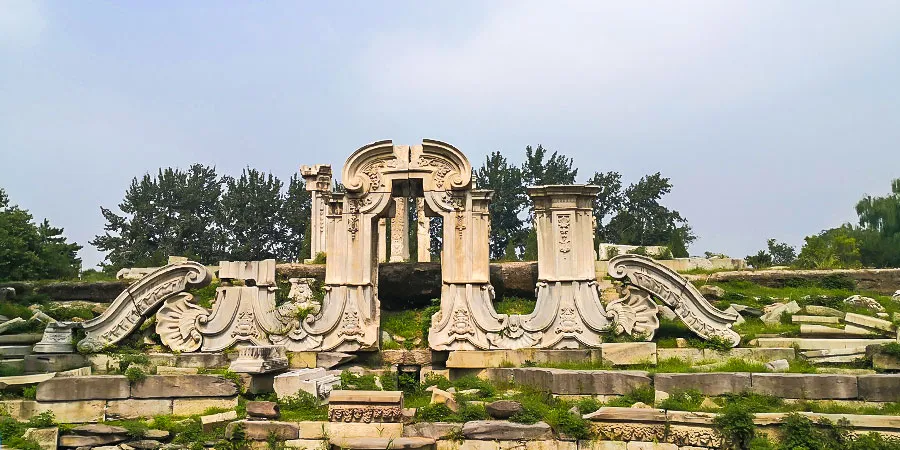
The ruins of the European Palaces are the most recognizable feature. The Dashuifa, or Great Fountains, and the nearby Haiyantang survive as broken stone structures that frame the sky. Their value is historical as much as visual: they mark the site of the 1860 destruction and the later loss of objects, including the zodiac animal heads that have been returned and displayed in stages.
The park is also a living landscape. Fuhai Lake, the maze at Huanghuazhen, the model exhibition, and the tree-lined avenues give the site a quieter character beyond the ruins. Visitors who enjoy history, garden design, photography, and long walks will find the most here. Families with children often appreciate the open space and the model display, while travelers with limited time can focus on the ruins area.
Tickets: Buy the Combined Ticket If You Want the Ruins
The single most important ticket decision is whether to buy basic entrance or the combined ticket. Basic admission generally covers the park grounds, while the European palace ruins and the model exhibition are usually covered by the higher-priced combined ticket. Several sources report a combined ticket around RMB 25, but prices and inclusions vary by source and season, so verify before purchase.
| Ticket type | Typical coverage | Notes |
|---|---|---|
| Basic entrance | Park grounds and lake areas | Usually does not include the European palace ruins |
| Combined ticket | Entrance plus European palace ruins and model exhibition | Best choice for first-time visitors; confirm current inclusions |
| Separate add-on tickets | Ruins area or model exhibition individually | Reported by some sources; availability should be checked |
| Concessions | Reduced or free entry for eligible groups | Rules vary; bring valid ID or passport |
Book through the official WeChat account or mini-program for the park where possible. Some sources say no reservation is required and tickets can be bought on site, while others describe advance booking with real-name registration. Treat this as uncertain and check the official channel shortly before your visit. Avoid touts and unofficial sellers, and do not rely on third-party listings for entry rules.
Opening Hours: Seasonal and Subject to Change
The park operates on seasonal schedules, with longer hours from April through October and shorter hours from November through March. Sources disagree on exact opening, last-entry, and closing times, and some distinguish between gate opening, ticket sales, and last admission. Use the table as a planning guide only.
| Season | Reported park hours | Last entry | Notes |
|---|---|---|---|
| April 1 to October 31 | Roughly 6:00 or 7:00 to 21:00 | Usually around 19:00 | Sources differ on gate opening and ticket sales times |
| November 1 to March 31 | Roughly 6:30 or 7:00 to 19:30 | Usually around 17:30 | Confirm before a late-afternoon visit |
| Inner sites and exhibitions | Shorter than park hours | Earlier than park closing | Model exhibition and museum may close earlier |
Some sources note that passes stop being sold and entry stops a set time before closing. Exhibition halls and the museum may follow separate schedules, and some reports mention Monday closures for indoor displays. Holiday periods can bring adjusted hours and free-admission days. Check the official account on the day of your visit.
Getting There
The park sits in northwest Beijing near the Summer Palace and Tsinghua University. Metro Line 4 serves the area, and several sources point to Yuanmingyuan Park station as the closest stop for the South Gate. Exit details and walking distances are not fully confirmed by an official transport source, so follow station signage rather than relying on a single exit number.
Taxis and ride-hailing are practical from central Beijing, though traffic can be heavy on weekends and holidays. Driving is possible, with parking reported near some gates, but spaces are limited and not recommended during peak periods. If you arrive by car, allow extra time and expect to walk from the lot.
The park has multiple gates, and the South Gate and East Gate are the most commonly used for the main highlights. The East Gate is often recommended for a shorter visit focused on the ruins. Check which gate your ticket or booking specifies, and confirm gate opening times before you go.
Insider tip: Enter early in the morning or after mid-afternoon. Tour groups tend to concentrate between late morning and mid-afternoon, and the ruins photograph best in softer light.
Suggested Routes
Classic Highlights Route
Duration: About 3 hours. Start: South Gate. End: East Gate.
South Gate → Zhengjue Temple area → model exhibition → European palace ruins → Dashuifa → Haiyantang → Huanghuazhen maze → Fuhai Lake → East Gate.
Terrain: Mostly flat paved paths with some uneven stone surfaces at the ruins. This route covers the main historical sights and a lake walk.
Short Ruins Route
Duration: About 2 hours. Start: East Gate. End: East Gate.
East Gate → European palace ruins → Dashuifa → Haiyantang → Huanghuazhen maze → return to East Gate.
Terrain: Flat and compact. Suitable for visitors with limited time or reduced stamina who want the core ruins.
Garden and Lake Route
Duration: About 3 to 4 hours. Start: South Gate. End: South Gate.
South Gate → Fuhai Lake → lakeside paths → garden areas → model exhibition → return to South Gate.
Terrain: Long but gentle walking. Best in spring and autumn, when the lakeside is comfortable and the trees show color.
Full-Day In-Depth Route
Duration: About 4 to 5 hours. Start: South Gate. End: East Gate.
South Gate → Zhengjue Temple → model exhibition → European palace ruins → Huanghuazhen → Fuhai Lake → garden paths → East Gate.
Terrain: Extensive walking on paved and stone paths. Bring water and plan a rest stop.
Must-See Highlights
Dashuifa (Great Fountains)
The surviving stone columns of the great fountain are the park’s signature image. They stand against open sky and show the scale of the former European-style complex. Visit in softer light for the most striking view, and do not climb on the stones.
Haiyantang (Hall of Tranquil Sea)
This was the site of the famous zodiac animal-head water clock. The original heads were dispersed, and several have since been returned and displayed. The foundation and surviving elements help explain how the fountain system worked.
Yuanyingguan (View of Distant Seas)
Another ruined European-style structure, Yuanyingguan adds to the group of stone remains that define the western part of the ruins area. Look for the carved details that survive on the stone.
Huanghuazhen Maze
The European-style stone maze is a playful contrast to the solemn ruins. It is popular with families and photographers. Walk through at an easy pace and avoid blocking the paths during busy periods.
Model Exhibition
A large-scale model shows the garden as it appeared at its height. Seeing the model before or after the ruins makes the scale of the loss easier to understand. Check the exhibition’s separate hours before planning your route.
Zhengjue Temple and the Museum Area
Zhengjue Temple is described as one of the best-preserved ancient building groups in the park and now houses museum displays. Returned relics, including animal heads, are a focus. Some reports say the museum requires a separate booking, so confirm in advance.
Fuhai Lake
The largest lake in the park offers open water, lotus in summer, and reeds in autumn. Black swans are sometimes seen. It is a good place to slow down after the ruins and a strong choice for a picnic-style rest, though food options inside are limited.
Ginkgo Avenue
In late October and early November, the ginkgo trees along the main paths turn golden. The avenue is a seasonal highlight and a popular photography spot. Arrive early to avoid crowds.
Best Time to Visit
Spring brings flowering trees and peonies, with mid-April to early May often cited as the peak for peony displays. Summer is hot and humid but rewards visitors with lotus blooms on Fuhai Lake. Autumn is the most comfortable season for walking, with ginkgo color and clear light. Winter is quiet and cold, and the ruins can look stark, especially after snow.
Early morning is the calmest time, and late afternoon gives the best light on the stone ruins. The park is large, so avoid starting a full circuit in the last two hours before closing. Chinese public holidays, especially the National Day period in early October and the Spring Festival, bring heavy crowds. Weekdays outside school holidays are usually more relaxed.
Night access is not a reliable feature of a visit; the park closes in the evening, and inner exhibitions close earlier. Plan around daylight and confirm seasonal closing times.
Common Mistakes to Avoid
- Buying only basic admission. The European palace ruins are the core sight for many visitors and may require the combined ticket. Check inclusions before buying.
- Assuming hours are fixed. Seasonal schedules and last-entry times vary between sources. Confirm on the official channel.
- Arriving at the wrong gate. The South Gate and East Gate serve different routes. Check which gate suits your plan.
- Underestimating the walking distance. The park is about 350 hectares. Wear comfortable shoes and allow rest time.
- Visiting the ruins at midday in summer. The area is exposed. Go early or late for comfort and better light.
- Climbing on the ruins. The stone structures are fragile and protected. Stay on the paths.
- Relying on unofficial guides. Use official audio guides or signage rather than unlicensed sellers.
- Expecting many restaurants inside. Food options are limited and can be expensive. Eat before or after, or bring snacks.
- Ignoring holiday crowds. Public holidays can be extremely busy. Visit on a weekday if possible.
- Forgetting identification. Carry your passport for ticket checks and any real-name booking.
- Missing the model exhibition. It gives context to the ruins and is included in some combined tickets.
- Planning a late entry. Ticket sales and entry stop before closing. Arrive with enough time for your route.
What to Bring
- Comfortable walking shoes with good grip for stone paths.
- Your passport for identification and ticket checks.
- A refillable water bottle, especially in summer.
- Sun protection: hat, sunglasses, and sunscreen for the exposed ruins area.
- A light jacket in spring and autumn, when lakeside breezes can be cool.
- Snacks for a long circuit, since indoor dining is limited.
- A charged phone for mobile payments and official booking apps.
- A power bank for a full day of navigation and photography.
- Rain gear in summer, when sudden showers are possible.
- A small bag that meets any security-check requirements; avoid prohibited equipment.
Food and Drink Nearby
Dining inside the park is limited. Small shops and snack counters near the main routes sell drinks and light food, but prices are often higher than outside. For a proper meal, plan to eat before entering or after leaving.
The area around the South Gate and the nearby university district has a range of casual restaurants, noodle shops, and cafes. The Summer Palace area to the west also has dining options near its gates. Exact businesses change, so check current listings and opening hours rather than relying on a single recommendation.
For a simple plan, eat a full meal near your metro stop before entering, carry water and snacks for the walk, and have a late lunch or early dinner after exiting. Mobile payment is widely used in Beijing, but keep a small amount of cash as a backup.
Final Thoughts
Yuanmingyuan Park rewards visitors who treat it as both a garden and a historical site. The ruins of the European Palaces carry the weight of the 1860 destruction, while the lakes, trees, and model exhibition show what the imperial garden once was. Allow about three hours for the highlights, or four to five hours for a fuller walk.
Go early, buy the right ticket, and confirm the seasonal hours before you set out. Stand before the broken stone columns of the Dashuifa in late-afternoon light, with the lake and trees behind you, and the contrast between loss and recovery becomes the memory you take away.
Sources
- Beijing Municipal Government: Yuanmingyuan Park overview
- Beijing Municipal Government: Yuanmingyuan Ruins Park
- China Daily: Yuanmingyuan Park guide
- China.org.cn: Old Summer Palace history and status
- CCTV: Guide to imperial gardens in Beijing
- Summer Palace official site: hours and transport
- Trip.com: Yuanmingyuan Museum and route notes
- Trip.com: Old Summer Palace travel guide
- Trip.com: Lion Grove and seasonal notes
- Trip.com: Old Summer Palace route notes