The Beijing Central Axis is the spine of the Chinese capital. Stretching 7.8 kilometers from north to south through the heart of the old city, it is an ensemble of palaces, gardens, sacrificial sites, and public buildings that has shaped Beijing’s urban layout for more than 700 years.
In July 2024, the Beijing Central Axis was inscribed on the UNESCO World Heritage List as “A Building Ensemble Exhibiting the Ideal Order of the Chinese Capital,” becoming China’s 59th World Heritage Site. Since then, visits to the scenic areas along the axis have surged significantly.
This guide will help you understand what the Central Axis is, which sites to prioritize, how to walk or cycle it, and how to avoid the crowds.
Quick Facts
- UNESCO World Heritage: Inscribed in July 2024
- Length: 7.8 kilometers from north to south
- Heritage elements: 15 components
- Northern terminus: Bell Tower and Drum Tower
- Southern terminus: Yongdingmen Gate
- Best time to visit: Spring (April–May) and autumn (September–October)
- Recommended duration: 1 day for walking; 2–3 hours for cycling
- Must-have: Passport, advance reservation for key sites, comfortable shoes and water
What Is the Beijing Central Axis?
The Central Axis is not a single building or a single street. It is a continuous line of architectural and ceremonial spaces that runs through the center of Beijing’s old city. At its northern end stand the Bell Tower and Drum Tower. The axis then runs south through Wanning Bridge, Jingshan Hill, the Forbidden City, Duanmen Gate, Tian’anmen Gate, the Outer Jinshui Bridges, the Tian’anmen Square Complex, Zhengyangmen Gate, and the archaeological remains of the southern section road, before terminating at Yongdingmen Gate.
Flanking the axis to the east and west are the Imperial Ancestral Temple, the Altar of Land and Grain, the Temple of Heaven, and the Altar of the God of Agriculture.
Together, these 15 components represent the mature stage of Chinese capital city planning. The axis embodies the traditional Chinese philosophy of “neutrality and harmony” and is the best-preserved capital central axis in China.
The 15 Heritage Components
| # | Component | Location / Notes |
|---|---|---|
| 1 | Bell and Drum Towers | Northern end; ancient timekeeping center |
| 2 | Wanning Bridge | Over the Yu River, near Shichahai |
| 3 | Jingshan Hill | Best panoramic view of the axis |
| 4 | Forbidden City (Palace Museum) | Imperial palace; closed Mondays |
| 5 | Duanmen Gate | South of the Forbidden City |
| 6 | Tian’anmen Gate | Iconic gate; security checks required |
| 7 | Outer Jinshui Bridges | In front of Tian’anmen |
| 8 | Tian’anmen Square Complex | National Museum, Great Hall, Monument |
| 9 | Zhengyangmen Gate | Also known as Qianmen |
| 10 | Southern Section Road Archaeological Sites | Remains of the original axis road |
| 11 | Imperial Ancestral Temple | East of Tian’anmen |
| 12 | Altar of Land and Grain | West of Tian’anmen |
| 13 | Temple of Heaven | East of the axis, south of Qianmen |
| 14 | Altar of the God of Agriculture | West of the axis |
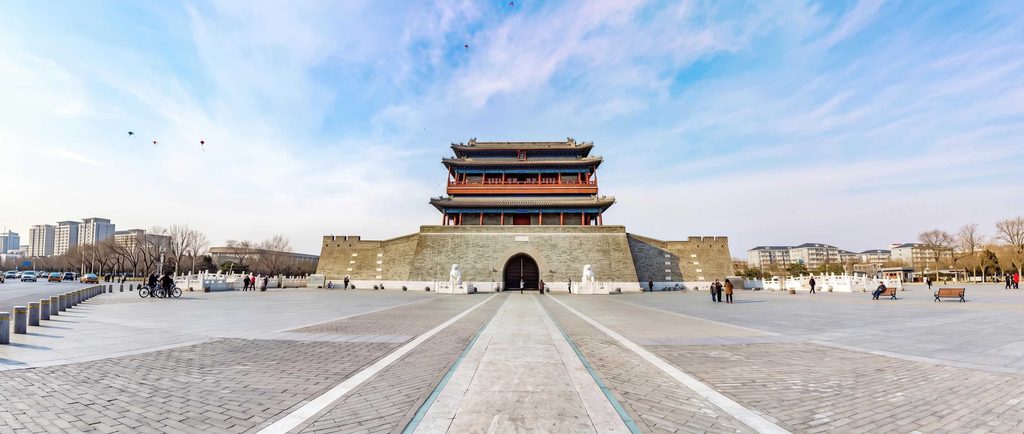
| 15 | Yongdingmen Gate | Southern terminus; rebuilt in 2004 |
Why Visit the Central Axis?
The Central Axis is more than a collection of landmarks. It is a way to understand how Beijing was designed as an imperial capital. The layout follows Confucian principles of order and symmetry, and it has influenced urban planning far beyond China.
For travelers, the axis offers a rare chance to walk through 700 years of history in a single route. You can start at the Bell and Drum Towers in the morning, walk south through the Forbidden City and Tian’anmen Square, and end at Yongdingmen Gate in the afternoon. Along the way, you pass imperial palaces, sacrificial altars, public squares, and lively hutong neighborhoods.
The axis is also a living part of the city. Local residents practice tai chi in Jingshan Park, shop in Qianmen, and gather in Tian’anmen Square. Exploring the axis on foot or by bike gives you a sense of both imperial grandeur and everyday Beijing life.
Tickets and Booking
The Central Axis itself is free to walk along. Individual sites charge separate admission fees, and some require advance reservation.
Key ticket prices:
| Site | Price | Booking Notes |
|---|---|---|
| Forbidden City | 60 RMB peak / 40 RMB off-season | Book 7 days in advance via official mini-program; closed Mondays |
| Jingshan Park | 2 RMB | On-site or online |
| Temple of Heaven (combo) | 34 RMB peak / 28 RMB off-season | Book via official mini-program |
| Bell and Drum Towers | Varies | Check official channels |
| Zhengyangmen Archery Tower | 20 RMB | Book via “Beijing Central Axis Heritage Protection Center” WeChat account; tickets released daily at 5:00 PM |
| Yongdingmen Gate | Free (exterior) | Rebuilt in 2004; open area |
Important: Several sites along the axis are closed on Mondays, including the Forbidden City. Heritage sites along the axis were open to the public on a recent Monday, but this was a special arrangement; normally, they are closed on Mondays. Always confirm opening days before your visit.
Getting Around the Axis
The Beijing Municipal Commission of Transport recommends two eco-friendly options for exploring the Central Axis: Subway Line 8 and Bus No. 5.
Subway Line 8
Line 8 runs north-south and mirrors the Central Axis underground. It has 34 stations, with notable stops at Qianmen, Wangfujing, Gulou, Shichahai, Nanluoguxiang, and Yongdingmen. The subway cars are decorated with images of the 15 ancient buildings along the axis. During peak season, trains run every 4 minutes.
Bus No. 5
Bus No. 5 offers panoramic views of the axis above ground. It starts at Caihuying Flyover and passes landmarks including Qianmen and Tian’anmen. The bus has a looping audio guide and a QR code for in-depth cultural insights.
Walking
Walking the full 7.8-kilometer axis is feasible for fit travelers. It takes about 2 hours without stops, but allow 4–6 hours to visit the major sites. The route is mostly paved and flat, but security checks at Tian’anmen Square can take 15–20 minutes during peak times.
Cycling
Cycling is one of the best ways to cover the full axis. A guided night bike tour is available, and a self-guided ride from Yongdingmen to the Bell and Drum Towers takes about 2 hours. Shared bikes are widely available, but be aware of restricted areas near Tian’anmen Square.
Suggested Routes
Half-Day Essential Walk (South to North)
Yongdingmen Gate → Temple of Heaven (optional detour east) → Qianmen Street → Zhengyangmen Gate → Tian’anmen Square → Tian’anmen Gate → Forbidden City (exterior or full visit) → Jingshan Park → Bell and Drum Towers
This route follows the axis from south to north, which matches the traditional imperial procession. It covers the most iconic sites. If you want to enter the Forbidden City, budget at least 3 hours there and start early.
Full-Day Deep Route
Morning: Yongdingmen Gate → Temple of Heaven → Qianmen Street and Dashilan
Afternoon: Zhengyangmen Gate → Tian’anmen Square → Forbidden City → Jingshan Park
Evening: Bell and Drum Towers → Shichahai → Yandai Xiejie
This route combines the axis with the lively commercial and hutong areas around it. It is best for travelers who want to see both heritage sites and local life.
Night Cycling Route
Yongdingmen Gate → Temple of Heaven → Sanlihe Park → Meridian Gate of the Forbidden City → Bell and Drum Towers
This 12-kilometer route takes about 2.5 hours and showcases the axis illuminated at night. It is ideal for photography and avoiding daytime crowds.
Northern Section Focus
Bell and Drum Towers → Wanning Bridge → Shichahai → Yandai Xiejie → Jingshan Park
This shorter route focuses on the northern part of the axis, where you can climb Jingshan Hill for a panoramic view of the Forbidden City and the axis stretching south.
Must-See Highlights
- Bell and Drum Towers: The northern anchor of the axis, once the city’s timekeeping center. The Drum Tower offers views over the surrounding hutongs.
- Jingshan Hill: The highest point on the axis and the best place to see the Forbidden City’s golden roofs from above. The Wanchun Pavilion is the classic photo spot.
- Forbidden City: The imperial palace at the center of the axis. Enter from the Meridian Gate and exit at the north gate.
- Tian’anmen Square: The ceremonial heart of the axis. The daily flag-raising ceremony at sunrise draws crowds year-round.
- Zhengyangmen Gate (Qianmen): The southern gate of the inner city, now a museum and observation point.
- Temple of Heaven: A detour east of the axis, but an essential UNESCO site with the Hall of Prayer for Good Harvests and the Circular Mound Altar.
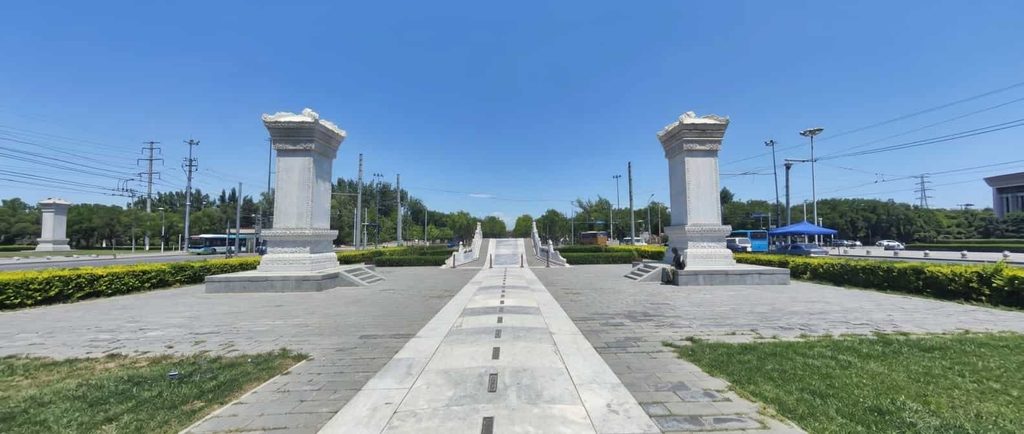
- Yongdingmen Gate: The southern terminus, rebuilt in 2004 on its original site. It marks the start or end of a full axis walk.
Best Time to Visit
Spring (April–May) and autumn (September–October) offer the most comfortable weather for walking and cycling. Average temperatures are mild, and the air is often clearer.
Late afternoon into early evening is ideal for photography along the axis, especially around Qianmen and Jingshan. For the Forbidden City and Tian’anmen Square, arrive early to avoid crowds and security lines.
Avoid Chinese public holidays, especially National Day Golden Week (October 1–7), Labor Day holiday (around May 1–5), and Spring Festival (January or February).
Common Mistakes to Avoid
- Trying to see everything in one day. The axis is 7.8 kilometers long, and the Forbidden City alone requires 3–5 hours. Prioritize.
- Forgetting advance bookings. The Forbidden City, Temple of Heaven, and Zhengyangmen Archery Tower require reservations.
- Visiting on a Monday. Many key sites, including the Forbidden City, are closed.
- Skipping Jingshan Park. The view from the top is the best way to understand the axis layout.
- Not bringing your passport. It is required for entry to most major sites.
- Underestimating security checks. Tian’anmen Square security can take 15–20 minutes during peak times.
- Walking the axis in the wrong direction. South-to-north follows the imperial route and ends with the best views.
- Assuming the axis is a single street. It passes through gates, squares, and parks. Use a map to navigate.
What to Bring
- Passport and booking confirmations
- Comfortable walking shoes
- Water and snacks
- Sun protection in summer
- Warm layers in winter
- Power bank and mobile payment app
- Camera or phone for photos
- A translation app for Chinese signage
Final Thoughts
The Beijing Central Axis is the city’s most important cultural and architectural line. It connects imperial palaces, sacrificial altars, public squares, and local neighborhoods into a single 7.8-kilometer journey through more than 700 years of history.
Whether you walk it in a day, cycle it at night, or focus on a single section, the Central Axis offers a unique way to experience Beijing. With advance planning, the right ticket bookings, and an early start, you can explore this UNESCO World Heritage Site at its best.