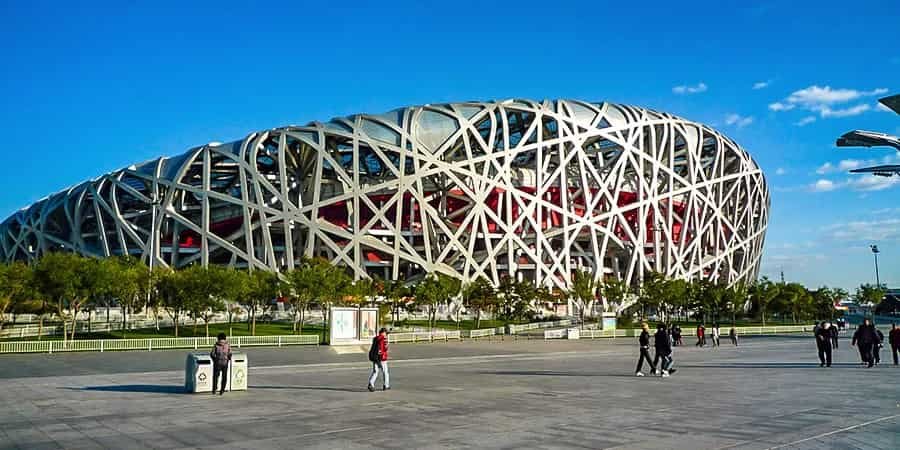
Beijing Olympic Park, also known as the Olympic Green, is one of the city’s most impressive modern attractions. Built for the 2008 Summer Olympics and later expanded for the 2022 Winter Olympics, it is a sprawling complex of world-class sporting venues, innovative architecture, and expansive green spaces.
The park sits at the northern end of Beijing’s Central Axis and covers approximately 11.59 square kilometers. It is a 5A National Tourist Attraction, the highest rating for scenic sites in China. It blends Olympic legacy, cultural venues, ecological landscapes, and public leisure spaces into one open urban destination.
This guide will help you plan your visit, choose the right route, avoid common mistakes and see the best of the Olympic Park.
Quick Facts
- Location: Chaoyang District, Beijing, at the northern end of the Central Axis
- Built for: 2008 Summer Olympics; expanded for 2022 Winter Olympics
- Area: Approximately 11.59 square kilometers
- Scenic rating: 5A National Tourist Attraction
- Park entry: Free
- Venue entry: Bird’s Nest 50 RMB; Water Cube 30 RMB; combo ticket 80 RMB
- Best time to visit: Late afternoon into evening
- Recommended duration: 3–5 hours
- Must-have: Passport, comfortable shoes, water and sun protection
Why Visit Beijing Olympic Park?
The Olympic Park is more than a collection of sports venues. It is a symbol of modern Beijing, a public park, and a showcase of sustainable urban design.
The park’s design emphasizes ecological harmony, with over 95% green coverage in areas such as the Olympic Forest Park. Wide pedestrian boulevards, water features, sculptures, and open plazas make it a pleasant place to walk, cycle, or simply relax.
The park is also a living part of the city. Local residents jog, cycle, and stroll here year-round. In the evening, the area transforms as the Bird’s Nest and Water Cube light up, creating one of Beijing’s most photogenic night scenes.
Tickets: Park Free, Venues Paid
The Olympic Park itself is free to enter. You can walk along the Central Axis landscape boulevard, admire the exterior of the stadiums, and explore the public areas without a ticket.
Tickets are only required to enter the interior of the major venues.
Ticket prices:
| Venue | Price | Notes |
|---|---|---|
| Bird’s Nest (National Stadium) | 50 RMB | Basic admission; exterior free |
| Bird’s Nest Sky Corridor | 80 RMB | Includes admission + top observation deck |
| Bird’s Nest VIP Ticket | 110 RMB | Includes admission + Sky Corridor + VIP access |
| Water Cube (National Aquatics Center) | 30 RMB | Half-price for students |
| Water Cube Water Park | ~200 RMB | Family-friendly |
| Combo Ticket (Bird’s Nest + Water Cube) | 80 RMB | Saves 20 RMB compared to separate tickets |
| Olympic Tower | 128 RMB | Observation deck; exterior viewing is free |
How to book:
- Use the official WeChat mini-programs for each venue.
- Avoid buying from scalpers at the entrance.
- Bring your passport for real-name verification.
- Combo tickets offer the best value if you plan to enter both the Bird’s Nest and Water Cube.
Important: The Water Cube is closed on Mondays, except for public holidays. The Bird’s Nest may also have adjusted hours during events. Always check official channels before your visit.
Opening Hours
| Area | Peak Season (May 1 – Oct 31) | Off-Season (Nov 1 – Apr 30) |
|---|---|---|
| Olympic Park (public areas) | 6:30 – 22:00 | 7:30 – 21:30 |
| Bird’s Nest (interior) | 9:00 – 18:00 | 9:00 – 17:00 |
| Water Cube (interior) | 10:00 – 21:00 | 10:00 – 18:00 |
| Olympic Tower | 9:00 – 22:00 | 9:00 – 21:00 |
The public park areas are open for most of the day, and the Central Plaza is accessible all day. The park has been transformed into an open urban space with 24-hour access in recent years, and bicycles are permitted to enter. However, venue interiors still follow fixed opening hours.
Getting There
The Olympic Park is well connected by public transport. The subway is the easiest and most reliable option.
- By Metro: Take Line 8 or Line 15 to Olympic Park Station. Exit D leads directly to the Central Axis landscape boulevard, about a 5-minute walk to the core area. For the Bird’s Nest and Water Cube, Olympic Sports Center Station on Line 8 is also convenient; Exit B2 is closest to the Bird’s Nest.
- By Bus: Routes 81, 82, 510, 607, 386, 407, 645, 658, and many others stop near the park. Get off at stops such as “National Stadium East (Bird’s Nest)” or “Olympic Sports Center.”
- By Taxi: Taxis can drop you near the park, but they cannot enter the pedestrian areas. You will still need to walk to the venues.
- By Car: Parking is limited and can be expensive on weekends. Public transport is strongly recommended.
Insider tip: If you are coming from central Beijing, take Line 10 to Beitucheng and transfer to Line 8. The transfer is straightforward and well-signposted.
Suggested Routes
3-Hour Essential Route (No Backtracking)
Olympic Park Station (Exit D) → Central Axis Landscape Boulevard → Linglong Tower → Water Cube → Bird’s Nest → Olympic Tower (night view)
This route follows the park from south to north and covers all the major landmarks. Start at the landscape boulevard, photograph Linglong Tower with both stadiums in one shot, then visit the Water Cube and Bird’s Nest. Finish at the Olympic Tower as the lights come on.
Half-Day Deep Route
Olympic Sports Center Station (Exit B2) → Bird’s Nest (interior) → Water Cube (interior) → Linglong Tower → Olympic Tower → Olympic Forest Park (South Park)
This route includes interior visits to both stadiums and adds a walk in the Olympic Forest Park. The South Park features Yangshan Hill and Aohai Lake, offering a quieter natural contrast to the architectural highlights.
Family-Friendly Route
Water Cube (Water Park) → Bird’s Nest (exterior) → Central Axis Landscape Boulevard → Olympic Forest Park (South Park) → New Olympic Shopping Center (dinner)
This route is relaxed and suitable for children. The Water Cube’s indoor water park is a highlight, and the shopping center near the metro station offers a wide range of dining options.
Photography and Night View Route
Linglong Tower Plaza (late afternoon) → Water Cube (blue hour) → Bird’s Nest (night illumination) → Olympic Tower (night view)
This route is designed for photographers. The Linglong Tower area offers a classic double-landmark shot of the Bird’s Nest and Water Cube together. The Water Cube’s blue bubble façade is best photographed at dusk, and the Bird’s Nest lights up around 19:00–19:30. The Olympic Tower observation deck provides a panoramic night view of the entire park.
Must-See Highlights
- Bird’s Nest (National Stadium): The iconic steel-lattice stadium designed by Herzog & de Meuron and Ai Weiwei. The exterior is free to view; the interior tour includes the track, stands, and a top observation deck.
- Water Cube (National Aquatics Center): Famous for its bubble-like ETFE façade. By day it looks like ice crystals; at night it glows in shifting blues and purples. The interior includes the pool, a water park, and a curling rink.
- Linglong Tower: A lesser-known photo spot with a small plaza that captures both the Bird’s Nest and Water Cube in one frame.
- Olympic Tower: A 246.8-meter tower with an observation deck offering 360-degree views of the Central Axis and the entire park. The night view is spectacular.
- Olympic Forest Park: The “green lung” of the park, with Yangshan Hill, Aohai Lake, and miles of walking and cycling paths. The South Park is more landscaped; the North Park is wilder and quieter.
- Central Axis Landscape Boulevard: A wide pedestrian avenue lined with Olympic sculptures, including a sundial and a replica of ancient Chinese bells. It is lively in the late afternoon with skaters, street performers, and families.
- Dragon-Shaped Water System: A shallow water feature near Linglong Tower, popular with children in summer. Weekend evenings sometimes feature music and fountain shows.
Best Time to Visit
The best seasons are spring (April–May) and autumn (September–October). The weather is mild, and the park is pleasant for walking.
Late afternoon into evening is the optimal time to visit. Arrive around 16:00–17:00 to see the venues in daylight, watch the sunset, and stay for the night illumination. The Bird’s Nest and Water Cube light up around 19:00–19:30, and the effect is dramatic.
Summer days can be hot with little shade on the open plaza. Winter is cold but quieter, and the venues look striking in snow.
Avoid Chinese public holidays, especially National Day Golden Week (October 1–7) and Labor Day holiday (around May 1–5), when crowds are heaviest.
Common Mistakes to Avoid
- Forgetting your passport. Real-name entry is required for the venues. No ID, no entry.
- Visiting on a Monday. The Water Cube is closed on Mondays. Some other venues may also have adjusted hours.
- Buying scalped tickets. Only use official mini-programs. Scalped tickets may not work.
- Arriving too late for the night view. The best light for photos is during the blue hour, just after sunset. Plan to be at the Water Cube or Bird’s Nest around 19:00.
- Underestimating walking distances. The park is over 11 square kilometers. Wear comfortable shoes and consider renting a sightseeing cart (about 30 RMB per person).
- Skipping the Linglong Tower photo spot. Many visitors miss this hidden gem, which offers the best double-landmark shot.
- Trying to see everything in one hour. The park deserves at least 3 hours, especially if you want to enter the venues.
- Assuming the park requires a ticket. The park itself is free. Only the venue interiors charge admission.
- Bringing prohibited items. Glass bottles and selfie sticks may be confiscated at security. There are storage facilities available.
- Forgetting a power bank. You will take many photos. Power bank rental inside the park costs about 5 RMB per hour.
What to Bring
- Passport and booking confirmations
- Comfortable walking shoes
- Water and snacks (there are shops inside, but prices are higher)
- Sun protection in summer (hat, sunscreen, sunglasses)
- Warm layers in winter
- Power bank for your phone
- Camera or phone for photos
- Insect repellent in summer evenings
Food and Drink Nearby
The Olympic Park has limited dining options inside, but there are excellent choices around the perimeter.
- New Olympic Shopping Center: Direct metro access at Olympic Park Station. Offers a wide range of restaurants, including Haidilao hotpot, Xibei Youmian Village (northwest Chinese cuisine), and Starbucks with outdoor seating facing the Bird’s Nest.
- Olympic Park Food Street: Inside the park, serving old Beijing zhajiang noodles (around 25 RMB), candied hawthorn skewers (around 15 RMB), and other snacks.
- Shuang’ao Food Street: A newer dining area near the venues, popular for its variety of Chinese and international options.
Final Thoughts
Beijing Olympic Park is one of the city’s most dynamic attractions. It combines world-class architecture, Olympic history, expansive green spaces, and vibrant public life. Whether you are a sports fan, a photographer, or simply looking for a pleasant place to walk, the park offers something for everyone.
With a free park entry, affordable venue tickets, and easy subway access, it is also one of Beijing’s most accessible major attractions. Plan your visit for late afternoon, bring your passport, and stay for the night view. The illuminated Bird’s Nest and Water Cube are an experience you will not forget.
Really appreciated the systematic breakdown presented in “Beijing Olympic Park Travel Guide: Tickets,…”. Looking forward to reading more of your insightful perspectives and follow-up work on this topic!