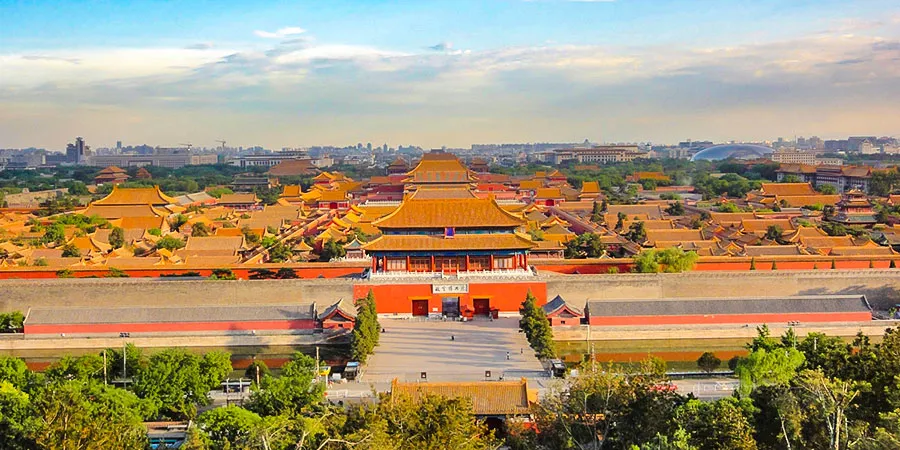
Jingshan Park is the single best place in Beijing to understand the city’s imperial layout. For just 2 RMB — the price of a bottle of water — you can climb to the highest point on Beijing’s Central Axis and look down on the golden roofs of the Forbidden City, the White Dagoba of Beihai Park, and the modern skyline beyond.
The park sits on Jingshan Hill, a 45.7-meter artificial mound directly north of the Forbidden City. It was built during the Ming Dynasty from earth excavated to create the palace moat, and it served as the imperial backyard during the Yuan, Ming and Qing dynasties.Jingshan was officially opened as a public park in 1928 and is now a 4A National Tourist Attraction and a key component of the UNESCO-listed Beijing Central Axis.
This guide will help you plan your visit, choose the fastest climbing route, and make the most of Beijing’s most affordable panoramic viewpoint.
Quick Facts
- Location: No. 44 Jingshan West Street, Xicheng District, directly north of the Forbidden City’s Shenwu Gate
- Hill height: 45.7 meters
- Scenic rating: 4A National Tourist Attraction
- Adult ticket: 2 RMB (10 RMB during special flower exhibitions)
- Best time to visit: Late afternoon before sunset, or early morning
- Recommended duration: 1–2 hours
- Must-have: Passport or ID, comfortable shoes, and a camera
Why Visit Jingshan Park?
Jingshan is not a large park, but its position is unmatched. The hill sits exactly on Beijing’s north-south Central Axis, and the bronze marker at the top of Wanchun Pavilion identifies the geometric center of Beijing’s inner city.
From the summit, you get a 360-degree panorama that no other single spot in Beijing can match:
- South: The full sweep of the Forbidden City, with its golden roofs stretching toward Tian’anmen Square.
- West: Beihai Park’s White Dagoba reflected on the lake.
- North: The Drum and Bell Towers, and the Olympic Tower in the distance.
- East: The modern CBD skyline, including the China Zun tower — a striking contrast of ancient and contemporary Beijing.
The park is also steeped in history. On the eastern slope is the site where Emperor Chongzhen, the last Ming emperor, hanged himself in 1644 as rebel forces entered the city. A stele and a transplanted locust tree mark the spot today.The northern section contains the Shouhuang Hall, a grand Qing Dynasty complex where emperors enshrined images of their ancestors.
Tickets: The Best Value in Beijing
At 2 RMB for an adult ticket, Jingshan is almost certainly the cheapest major attraction in Beijing.
| Ticket Type | Price |
|---|---|
| Adult | 2 RMB |
| Student | 1 RMB |
| Seniors 60+ | Free |
| Children under 1.3 m | Free |
During the Peony Culture Festival (typically April to May), the adult ticket is adjusted to 10 RMB and the discount ticket to 5 RMB.
How to book:
- Tickets can be purchased on-site at the gate, but advance online booking is recommended on weekends and holidays.
- Use the official “Visiting Beijing Parks” (畅游公园) WeChat public account — the only official online ticketing platform. Tickets are available up to 7 days in advance.
- Bring your passport or ID card. Entry is by scanning the document at the gate.
Important: The Shouhuang Hall and Guande Hall indoor exhibition halls are closed on Mondays, except for public holidays.
Opening Hours
| Season | Opening | Last Entry | Closing |
|---|---|---|---|
| Peak (April 1 – October 31) | 6:00 | 20:30 | 21:00 |
| Off-Season (November 1 – March 31) | 6:30 | 19:30 | 20:00 |
The Shouhuang Hall and other indoor halls operate from 8:00 to 18:00 in peak season and 8:30 to 17:00 in off-season.
Getting There
Jingshan has no internal parking, and surrounding parking is extremely limited. Public transport is strongly recommended.
- From the Forbidden City: Exit through the Shenwu Gate (north gate), cross the underground passage, and you arrive at Jingshan’s South Gate in about 3 minutes. This is the most convenient approach for anyone visiting the Forbidden City.
- By Metro: Take Line 8 to National Art Museum Station (Exit A) and walk about 10 minutes to the East Gate. Alternatively, Line 8 to Shichahai Station and walk about 12 minutes to the West or North Gate. Line 6 to Nanluoguxiang Station is also within walking distance of the East Gate.
- By Bus: Routes 101, 103, 109, 124 and others stop at Shenwumen Station near the South Gate. Routes 111 and 124 stop at Jingshan East Gate Station for the East Gate.
Suggested Routes
1-Hour Express Route (Best for Sunset)
South Gate → Qi Wang Tower → Hiking Path → Wanchun Pavilion (summit) → Return to South Gate
This is the fastest and most popular route. From the South Gate, turn left and follow the gentle climbing path. It takes about 10–15 minutes to reach the summit, and the path is easy enough for elderly visitors and children.Stay for sunset, then descend the same way.
1.5-Hour Classic No-Backtrack Route
South Gate → Qi Wang Tower → Site of Emperor Chongzhen’s Death (east slope) → East Hillside Path → Wanchun Pavilion → West Descent → Shouhuang Hall → East Gate or West Gate
This route covers the park’s two most important historical sites and the summit without retracing your steps. Start at the South Gate, visit Qi Wang Tower, then walk to the Chongzhen memorial on the eastern slope. Climb via the eastern path to Wanchun Pavilion, descend on the west side, and finish at the Shouhuang Hall complex.
2-Hour Five Pavilions Route
South Gate → Qi Wang Tower → Chongzhen Site → Zhoushang Pavilion → Guanmiao Pavilion → Wanchun Pavilion → Jifang Pavilion → Fulan Pavilion → Shouhuang Hall → West Gate
This route visits all five pavilions on the hill. The Five Pavilions were built during the Qianlong reign and are arranged symmetrically along the ridgeline. Wanchun Pavilion is the central and highest; the other four flank it on either side.
Avoiding Crowds Route (West Gate Entry)
West Gate → Shouhuang Hall → Fulan Pavilion → Jifang Pavilion → Wanchun Pavilion → Guanmiao Pavilion → Zhoushang Pavilion → Chongzhen Site → South Gate
The West Gate has significantly fewer visitors than the South Gate, and the slope is gentler. This route is recommended on holidays and weekends when the South Gate area becomes congested.
Must-See Highlights
- Wanchun Pavilion: The summit pavilion and the highest point on Beijing’s Central Axis. The bronze marker on the terrace marks the geometric center of the inner city. The 360-degree view is the main reason to visit Jingshan. Arrive 45–60 minutes before sunset for the best light and to secure a spot along the railing.
- Five Pavilions: Five distinct pavilions built in 1751 during the Qianlong reign, each with a different roof style. They are arranged in a symmetrical pattern along the hill’s ridgeline. The ancient trees around Guanmiao and Jifang Pavilions are especially photogenic.
- Site of Emperor Chongzhen’s Death: On the eastern slope, a stele and a locust tree mark where the last Ming emperor took his own life in 1644. The original tree is gone; the current one was transplanted in 1996.
- Shouhuang Hall: A grand Qing Dynasty complex used for imperial ancestor worship. The main hall has a double-eaved roof and nine bays, and the surrounding square is spacious and quiet. It is included in the basic ticket.
- Qi Wang Tower: A two-story building near the South Gate where emperors once rested before ceremonies. It offers a distant view of the Forbidden City’s corner towers.
- Peony Garden: From April to May, more than 20,000 peony plants of over 500 varieties bloom in the park. This is one of Beijing’s best spring flower displays and the reason for the temporary ticket price increase.
Best Time to Visit
Late afternoon is the optimal time. Arrive about an hour before sunset, climb to Wanchun Pavilion, and watch the Forbidden City’s golden roofs glow in the setting sun. The park stays open until 21:00 in peak season, and the night illumination of the Forbidden City and surrounding landmarks is visible from the summit on Friday and Saturday evenings.
Early morning (6:30–8:00) is the quietest time. The light is soft, the crowds are minimal, and you may have parts of the summit to yourself.
Spring (April–May) brings the peony festival and fresh greenery. Autumn (September–October) offers crisp air and clear views. Summer can be hazy, which reduces visibility from the summit. Winter is cold but often clear, and snow on the Forbidden City’s roofs is spectacular from above.
Common Mistakes to Avoid
- Skipping Jingshan after the Forbidden City. The park is directly across from the Shenwu Gate exit. It takes just 3 minutes to reach and 15 minutes to climb. It is the perfect finale to a Forbidden City visit.
- Arriving too late for sunset. The summit fills up quickly on clear evenings. Arrive at least 45 minutes before sunset to find a good spot.
- Visiting Shouhuang Hall on a Monday. The indoor exhibition halls are closed. The park itself remains open.
- Wearing slippery shoes. The stone paths and steps can be slippery, especially after rain. Wear shoes with good grip.
- Carrying heavy bags. There is no luggage storage at the summit, and the climb, while short, is steep in places. Travel light.
- Expecting a large park. Jingshan is compact. It is a viewpoint and a historical site, not a sprawling garden like Beihai or the Summer Palace.
- Forgetting your passport. Real-name entry requires an ID document.
- Trying to drive. Parking is nearly nonexistent. Take the metro or walk from the Forbidden City.
What to Bring
- Passport or ID card
- Comfortable walking shoes with good grip
- Water (there are limited vendors on the hill)
- Camera or phone for the panorama
- A light jacket for sunset (the summit is breezy)
- Power bank
Food and Drink Nearby
Jingshan has limited food options inside. The surrounding neighborhoods are far better.
- Di’anmen Snack Street: About 10 minutes on foot from the West Gate. Traditional Beijing snacks including zhajiang noodles, lu zhu (braised meat), and douzhi (fermented mung bean drink).
- Huguosi Street: About 15 minutes from the West Gate. Famous for sweet snacks such as wandouhuang (pea cake) and lǘdagun (glutinous rice rolls).
- Nanluoguxiang: About 15–20 minutes from the East Gate. A lively hutong street with cafes, snack stalls and shops.
- Wangchun Food Pavilion: In Sanyanjing Hutong near the East Gate, a courtyard restaurant with views of Jingshan from the second floor. Signature dishes include orange ribs and scallion pancakes, around 120 RMB per person.
Final Thoughts
Jingshan Park is the best-value attraction in Beijing. For 2 RMB, you get the definitive view of the Forbidden City, a lesson in imperial city planning, and a quiet climb that takes less than 15 minutes. It is the perfect complement to a Forbidden City visit and an essential stop on any Central Axis itinerary.
Whether you come for the sunset panorama, the peonies in spring, or the history of the Chongzhen site, Jingshan delivers far more than its price suggests. Combine it with Beihai Park to the west or the Shichahai hutongs to the north, and you have a complete day of imperial Beijing.