Zhongshan Park sits in the heart of Beijing’s Dongcheng District, directly west of Tian’anmen Tower and adjacent to the Forbidden City. Built in 1420 during the Ming Dynasty as the Altar of Land and Grain (Shejitan), it served as a sacred site where emperors performed over 1,300 sacrificial ceremonies to honor the gods of soil and harvest. The park was designated a National Key Cultural Relic in 1988 and rated a 4A National Tourist Attraction in 2011.
Unlike the grand scale of the Forbidden City, Zhongshan Park offers an intimate, human-scale experience. It is the only park in Beijing where you can stand on a five-colored soil altar that symbolized the emperor’s dominion over all directions. Locals gather here at dawn for tai chi, retirees sing Peking opera under ancient pavilions, and the century-old Laijinyuxuan teahouse still serves the winter vegetable buns that writer Lu Xun once favored.
This guide will help you plan your visit, choose the right route, avoid common mistakes, and make the most of your time. The site is smaller than most visitors expect, but the layers of history within its walls reward careful exploration.
Quick Facts
- Location: Dongcheng District, west of Tian’anmen Tower, adjacent to the Forbidden City
- Built: 1420, Ming Dynasty (Yongle Emperor)
- Scenic rating: 4A National Tourist Attraction
- Area: 23.8 hectares (58.8 acres)
- Park entry: 3 RMB (10 RMB during Tulip Festival, March–April)
- Venue entry: Separate fees for Huifang Garden and Tang Flower House
- Best time to visit: Spring (April–May) and autumn (September–October)
- Recommended duration: 1.5–3 hours
- Must-have: Passport for real-name reservation, comfortable shoes
- Metro access: Line 1, Tian’anmen West Station, Exit B
- Annual pass: 100 RMB for unlimited visits to multiple Beijing parks
Why Visit Zhongshan Park?
Zhongshan Park’s historical significance begins with its original function as the Altar of Land and Grain. From 1421 to 1911, emperors of the Ming and Qing dynasties performed sacrifices here to ensure bountiful harvests and affirm their mandate to rule. The altar’s five-colored soil layout—yellow at the center, green to the east, red to the south, white to the west, and black to the north—reflects the cosmological order of traditional Chinese thought.
The park’s transformation into a public space marked a turning point in Beijing’s urban history. In 1914, under the initiative of Zhu Qiqian, the Minister of the Interior, the former imperial altar became Central Park—the first public park in Beijing. In 1928, it was renamed Zhongshan Park in memory of Sun Yat-sen, the revolutionary leader who had lain in state in the park’s hall three years earlier.
Architecturally, the park preserves a remarkable collection of ancient trees, including cypresses that date to the Liao Dynasty, over 900 years old. The “Locust and Cypress Embrace”—where a locust tree and cypress grow intertwined—is a natural curiosity that draws visitors for its symbolic union of different eras.
Zhongshan Park differs from other Beijing attractions in its scale and atmosphere. While the Forbidden City overwhelms with imperial grandeur, Zhongshan Park invites contemplation. It is also home to the Forbidden City Concert Hall, where classical music performances are held in a setting that blends Chinese and Western architectural elements.
This park suits history lovers who want to understand the rituals that sustained imperial rule, photographers seeking red walls framed by golden ginkgo, and families looking for a flat, shaded space where children can walk freely.
Tickets: Book Online or Use the On-Site Window
The most important ticket tip: purchase your ticket through the official “Visiting Beijing Parks” WeChat mini-program or website before you arrive, especially during peak seasons. While Zhongshan Park does maintain an on-site ticket office, advance booking guarantees entry and saves time at the gate.
| Ticket Type | Price | Notes |
|---|---|---|
| Adult (regular) | 3 RMB | Standard admission year-round |
| Adult (Tulip Festival) | 10 RMB | March to April, includes Tang Flower House and Huifang Garden |
| Half-price (students) | 1.5 RMB | Valid student ID required |
| Half-price (Tulip Festival) | 5 RMB | Students during festival period |
| Children under 1.2 meters | Free | Height-based admission |
| Seniors (60+) | Free | Valid ID or senior card required |
| Annual pass | 100 RMB | Unlimited visits to multiple Beijing parks |
How to book:
- Open WeChat and search for “畅游公园” (Visiting Beijing Parks) mini-program.
- Register with your passport number and full name as shown on your passport.
- Select Zhongshan Park, choose your date and time slot, and complete payment.
- Booking opens 1–7 days in advance.
- Bring your passport on the day of visit for verification.
Important warnings:
- Tickets are non-transferable and tied to your passport number.
- Scalpers may offer “skip-the-line” tickets; these are not valid for entry.
- During Chinese public holidays, tickets sell out quickly; book as early as possible.
Opening Hours
| Season | Opening | Last Entry | Closing |
|---|---|---|---|
| Peak (June 1 – August 31) | 6:00 AM | 9:00 PM | 10:00 PM |
| Spring/Autumn (April 1 – May 31; September 1 – October 31) | 6:00 AM | 8:30 PM | 9:00 PM |
| Off-Season (November 1 – March 31) | 6:30 AM | 7:30 PM | 8:00 PM |
Inner attractions such as Huifang Garden and Tang Flower House typically close earlier than the park itself, usually around 5:00 PM. Arrive in the morning if you want to enter the paid inner attractions.
The park does not close on Mondays. However, some indoor exhibition spaces may have irregular hours. Check the official WeChat account for current schedules before your visit.
Getting There
Public transport is the recommended way to reach Zhongshan Park. The park sits within a security-restricted zone near Tian’anmen Square, and private vehicles face significant access limitations.
By Metro:
- Line 1: Exit at Tian’anmen West Station (天安门西站), Exit B. Walk east for approximately 5 minutes to the South Gate or West Gate of the park.
By Bus:
- Routes 1, 5, 52, and 99 stop at “Tian’anmen West Station” or “Zhongshan Park” station. From the bus stop, follow signs toward the park entrance.
By Taxi:
- Drivers can drop you near the West Gate on West Chang’an Avenue. They cannot drive directly to the South Gate due to security restrictions around Tian’anmen Square.
By Car:
- Parking is extremely limited and requires advance reservation. Driving is not recommended for most visitors.
Insider tip: If you are already visiting the Forbidden City, exit through the Meridian Gate and walk west. You can enter Zhongshan Park through the East Gate without passing through Tian’anmen security checkpoints. This route saves significant time.
Suggested Routes
1.5-Hour Essential Route (Best for first-time visitors with limited time)
South Gate → Peace Protection Archway → Sun Yat-sen Bronze Statue → Altar of Land and Grain (five-colored soil) → Zhongshan Hall → West Gate
Terrain: Flat, paved paths throughout. No stairs. Suitable for all mobility levels.
3-Hour Deep Discovery Route (Best for history enthusiasts)
South Gate → Peace Protection Archway → Ancient Cypress Area (Locust and Cypress Embrace) → Altar of Land and Grain → Zhongshan Hall (Sun Yat-sen exhibition) → Tang Flower House → Huifang Garden → Laijinyuxuan Teahouse (refreshment stop) → East Gate (exit toward Forbidden City)
Terrain: Mostly flat, some uneven stone paving near ancient trees. Includes two paid inner attractions (covered by Tulip Festival combo ticket).
2-Hour Family-Friendly Route (Best for children and strollers)
West Gate → Ancient Cypress Grove (shaded walking) → Children’s Playground → Waterside Pavilion (feed fish) → Altar of Land and Grain → South Gate
Terrain: Completely flat and stroller-accessible. Benches are spaced regularly along the route. The playground near the West Gate has equipment suitable for ages 3–10.
2-Hour Photography Route (Best light: 9:00–11:00 AM or 3:00–5:00 PM)
South Gate → Ginkgo Avenue (autumn) or Tulip Sea (spring) → Altar of Land and Grain (overhead shots of five-colored soil) → Red wall corridor near Zhongshan Hall → Waterside Pavilion (reflection shots) → West Gate
Terrain: Flat. Best visited on weekdays for fewer crowds in frames. Bring a wide-angle lens for the altar and a telephoto for compressed red-wall backgrounds.
Must-See Highlights
Altar of Land and Grain (Shejitan): The park’s core structure, a three-tiered square platform topped with five-colored soil representing the five directions. Built in 1420, this was where emperors prayed for good harvests. The altar is included in the base ticket. Best photographed from the southeast corner in morning light.
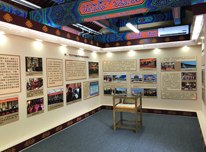
Zhongshan Hall: A grand wooden hall north of the altar, originally the “Hall of Worship” where emperors prepared for sacrifices. Since 1925, it has housed a permanent exhibition on Sun Yat-sen’s life and the 1911 Revolution. Entry is free with park admission.
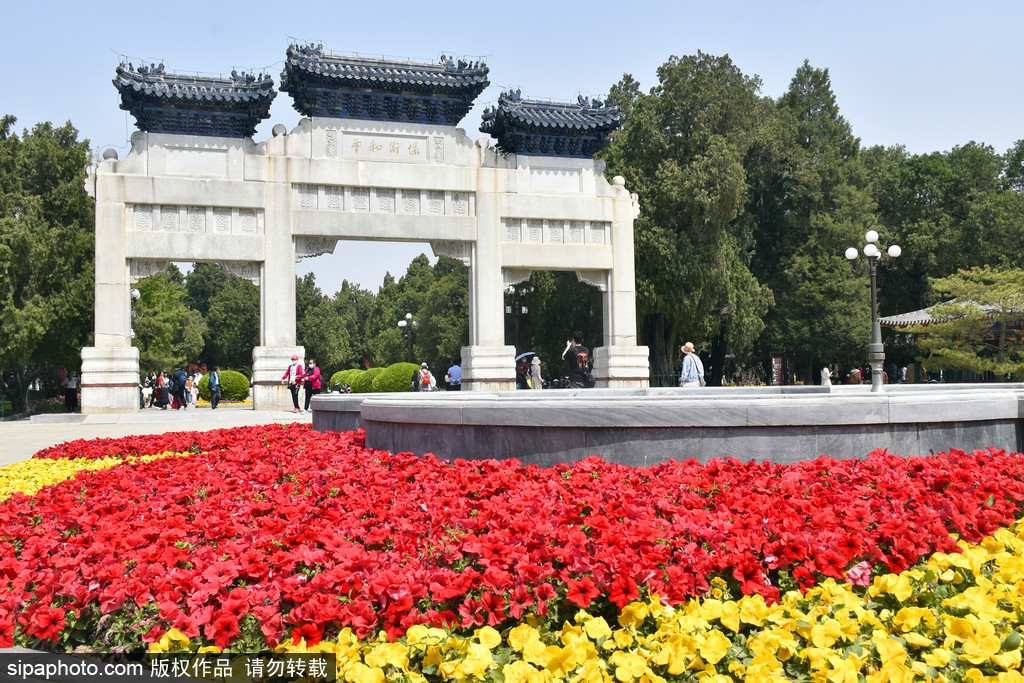
Peace Protection Archway: A tall white stone archway near the South Gate, originally erected in 1903 to commemorate German diplomat Baron von Ketteler. It was renamed “Peace Protection” in 1918 and stands as a witness to Beijing’s modern history.
Ancient Cypress Grove: Scattered throughout the park, especially around the altar, are cypresses dating to the Liao Dynasty (907–1125). The most famous is the “Locust and Cypress Embrace,” where two different trees have grown into a single intertwined trunk. A popular spot for photos and quiet contemplation.
Tang Flower House: A greenhouse shaped like swallow wings that displays rare flowers and bonsai year-round. It is especially vibrant during the winter months when outdoor blooms are scarce. Included in the Tulip Festival combo ticket.
Huifang Garden: A separate courtyard dedicated to orchids, bamboo, and seasonal specialty flowers. The garden offers a quiet escape from the main paths and is a favorite among photographers for its traditional Chinese garden design. Included in the Tulip Festival combo ticket.
Laijinyuxuan Teahouse: A century-old teahouse built in 1915, once a gathering place for writers including Lu Xun and Li Dazhao. Today it serves winter vegetable buns (2.5 RMB each), pea flour cake, and jasmine tea. Open 8:30 AM – 7:30 PM. Expect to spend 80–150 RMB for a full tea set.
Ginkgo Avenue: A 200-meter stretch of ginkgo trees near the South Gate and west of the Altar of Land and Grain. In late October and early November, the leaves turn brilliant gold against the park’s red walls. This is one of Beijing’s most photogenic autumn scenes.
Best Time to Visit
Best seasons: Spring (April–May) and autumn (September–October) offer the most comfortable temperatures. Spring brings the Tulip Festival—over 100 varieties bloom from mid-April to early May, a tradition dating to 1977 when the Dutch royal family gifted tulip bulbs to the park. Autumn turns the ginkgo trees golden in late October and early November.
Best time of day: Arrive at opening (6:00 AM) for quiet paths and soft morning light. Late afternoon (3:00–5:00 PM) provides warm light for photography and a relaxed atmosphere as locals gather for evening activities.
Seasonal highlights: Spring: tulips, magnolias, peach blossoms. Summer: lotus flowers in the waterside area, dense shade from ancient cypresses. Autumn: ginkgo Avenue, chrysanthemum displays. Winter: snow-covered red walls and ancient trees, with indoor flower exhibitions at Tang Flower House.
Chinese public holidays to avoid: National Day Golden Week (October 1–7), Labor Day holiday (around May 1–5), and Spring Festival (January or February). During these periods, the park and surrounding Tian’anmen area experience extreme crowding, and security checks take much longer.
Common Mistakes to Avoid
- Forgetting your passport — Real-name reservation and entry require your passport. Digital copies are not accepted at the gate.
- Assuming you can buy tickets at the gate during peak season — While an on-site ticket window exists, it often has long queues during tulip season. Book via the “Visiting Beijing Parks” WeChat mini-program before arrival.
- Entering through the South Gate without booking Tian’anmen Square — The South Gate sits within the Tian’anmen security zone. You may need a separate reservation for the square to access this entrance. The West Gate avoids this requirement entirely.
- Arriving after 4:00 PM expecting to see Huifang Garden — Inner attractions close around 5:00 PM, earlier than the park itself. Arrive by mid-afternoon for paid indoor spaces.
- Driving to the park — Parking is virtually unavailable without advance reservation. The metro is faster and more convenient.
- Wearing uncomfortable shoes — While the park is flat, you will cover more ground than expected. The Deep Discovery Route involves over 2 kilometers of walking.
- Missing the five-colored soil altar — Some visitors walk past the altar without realizing its significance. It is the geographic and historical center of the park.
- Visiting during National Day Golden Week — The first week of October brings overwhelming crowds to the entire Tian’anmen area. Choose a weekday in late October instead for autumn colors with fewer people.
- Expecting the park to be as large as the Forbidden City — Zhongshan Park covers 23.8 hectares and can be thoroughly explored in 2–3 hours. Plan it as a half-day activity, not a full-day destination.
- Not bringing cash or mobile payment — While the ticket office accepts cash, the teahouse and some vendors prefer WeChat Pay or Alipay. Set up mobile payment before your trip.
- Photographing the altar from the wrong angle — The five-colored soil is best viewed from the southeast corner in morning light. Shooting directly into the sun from the west washes out the colors.
- Ignoring the park’s connection to the Forbidden City — The East Gate opens directly toward the Meridian Gate. Combining both sites in one day is efficient, but requires separate tickets and advance booking for the Forbidden City.
What to Bring
- Passport (required for real-name entry and ticket verification)
- Booking confirmation (screenshot of your WeChat mini-program reservation)
- Comfortable walking shoes (the park is flat but expansive)
- Water bottle (refill stations are limited; vendors sell drinks near the South Gate)
- Sun protection (hat, sunscreen, sunglasses—shade is plentiful but the altar area is exposed)
- Warm layers in winter (the park is open in cold months, and wind near the altar can be sharp)
- Rain jacket or compact umbrella (summer thunderstorms arrive quickly)
- Power bank (for photos and mobile payment)
- Translation app (Chinese signage is limited; some historical markers lack English)
- Insect repellent in summer (especially near the waterside pavilion and dense cypress areas)
- Small backpack (large bags may require additional security screening at the gate)
Food and Drink Nearby
Laijinyuxuan Teahouse (Inside Park, near East Gate): Traditional Beijing teahouse serving winter vegetable buns (2.5 RMB each), pea flour cake, and jasmine tea. Budget 80–150 RMB for a tea set. A 10-minute walk from the South Gate. Open 8:30 AM – 7:30 PM.
Sijiminfu Roast Duck (Outside West Gate): Mid-range Beijing roast duck restaurant located just outside the park’s West Gate. A full duck meal for two costs approximately 200–300 RMB. Signature dish: traditional roast duck with pancakes and sweet bean sauce. A 2-minute walk from the West Gate.
Qianmen Street (15-minute walk south): A restored commercial street with numerous snack stalls and restaurants. Try zhajiangmian (noodles with soybean paste) and tanghulu (candied hawthorn skewers). Budget 30–60 RMB per person for street food. Accessible by walking south from the South Gate or via Metro Line 2 to Qianmen Station.
Donghuamen Night Market Area (10-minute walk east): Located along Donghuamen Street near the Forbidden City’s East Gate. Various small eateries serve dumplings, noodles, and quick Chinese meals. Budget 20–50 RMB per person. Best for a quick lunch before or after visiting the Forbidden City.
Forbidden City Concert Hall Cafe (Inside Park): A small cafe adjacent to the concert hall offering coffee, tea, and light snacks. Expect 30–50 RMB for a coffee and pastry. Convenient for a mid-visit break without leaving the park.
Final Thoughts
Zhongshan Park offers something increasingly rare in Beijing: a quiet, layered historical experience within walking distance of the city’s most famous landmarks. For 3 RMB, you can stand on the same altar where emperors prayed for harvests six centuries ago, then drink tea in a teahouse where Lu Xun once wrote.
Plan for 2–3 hours if you want to see the highlights without rushing. Visit in spring for tulips or autumn for ginkgo. Enter through the West Gate to avoid security delays, and bring your passport for the real-name ticket check. The park is not a substitute for the Forbidden City—it is a complement to it, a place where imperial ritual meets everyday Beijing life.
1 thought on this story