
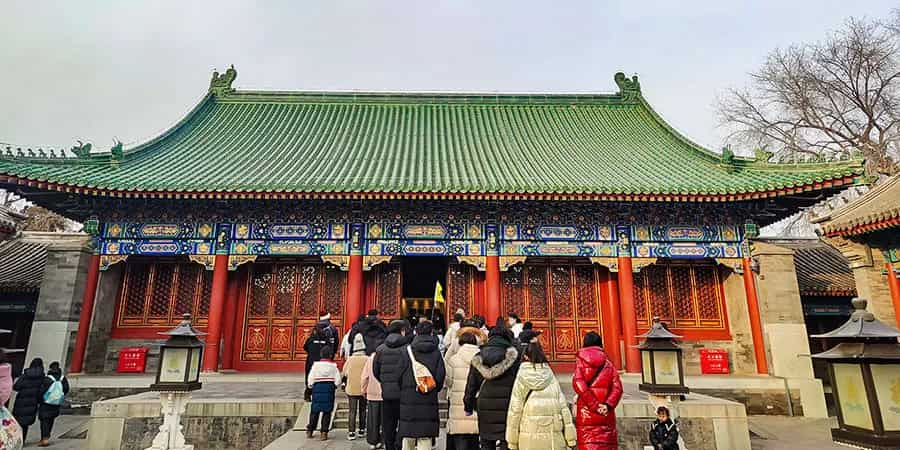
Prince Gong’s Mansion, officially known as the Prince Kung’s Palace Museum, is the largest and best-preserved princely residence from the Qing Dynasty in Beijing. Built in the Qianlong reign on the southern shore of Shichahai Lake, it was originally the residence of Heshen, a powerful and notorious minister. It later became the home of Prince Qing Yonglin and then Prince Gong Yixin.
The mansion covers more than 60,000 square meters and has witnessed the reigns of seven Qing emperors. A popular saying captures its historical weight: “One Prince Gong’s Mansion, half the history of the Qing Dynasty.”
Today it is a 5A National Tourist Attraction and a National Key Cultural Relics Protection Unit. It combines the grandeur of a northern princely mansion with the refinement of a Jiangnan garden. Whether you are interested in Qing history, architecture, or simply looking for a photogenic half-day trip near Shichahai, Prince Gong’s Mansion is a rewarding destination.
Quick Facts
- Location: No. 17 Qianhai West Street, Xicheng District, Beijing
- Historic residents: Heshen, Prince Qing Yonglin, Prince Gong Yixin
- Area: Over 60,000 square meters
- Scenic rating: 5A National Tourist Attraction
- Best time to visit: Spring and autumn; arrive at opening
- Recommended duration: 2.5–3 hours
- Must-have: Passport, advance reservation, comfortable shoes and water
Why Visit Prince Gong’s Mansion?
Prince Gong’s Mansion is not just a historic house. It is a complete princely estate, divided into two main parts: the residential complex in the front and the Cuijin Garden in the back. The residential section follows strict Qing regulations for princely residences, with a central axis of halls and side courtyards. The garden blends northern and southern landscape styles, with rockeries, ponds, pavilions, and covered walkways.
The mansion is also famous as the setting for several popular Chinese television dramas, including My Fair Princess and Empresses in the Palace. For visitors, it offers an intimate look at aristocratic life in the Qing Dynasty.
Tickets: Reserve Online, No On-Site Sales
The most important rule for visiting Prince Gong’s Mansion is simple: there is no on-site ticket window. All visitors must reserve in advance through official channels.
Ticket prices:
| Visitor Type | Price |
|---|---|
| Adult | 40 RMB |
| Full-time students | 20 RMB |
| Seniors aged 60+ | 20 RMB |
| Children under 1.2 m or aged 6 and under | Free |
| Disabled visitors | Free with valid certificate |
How to book:
- Use the official WeChat account “Prince Kung’s Palace Museum” or the official website.
- Reservations are real-name and usually open 10 days in advance at 20:00 Beijing time. Some sources indicate a 7-day advance window, so check the official account for current rules.
- Foreign visitors should use their passport for reservation and entry.
- During Chinese public holidays, book at least 3 days ahead. Tickets sell out quickly.
Important: The mansion is closed on Mondays, except for statutory public holidays. Do not plan a Monday visit unless it falls on a holiday.
Opening Hours
| Season | Opening | Last Entry | Closing |
|---|---|---|---|
| Peak (Apr 1 – Oct 31) | 8:30 | 16:10 | 17:00 |
| Off-season (Nov 1 – Mar 31) | 9:00 | 16:00 | 16:30 |
The mansion is open daily except Mondays. Arrive before 9:00 AM if possible, especially on weekends and holidays. The site has daily visitor limits, and afternoons can become very crowded.
Getting There
Prince Gong’s Mansion is located in a hutong area near Shichahai. Public transport is strongly recommended because parking is extremely limited.
- By Metro: Take Line 6 to Beihai North Station, Exit B (northeast exit). Walk along Sanzuoqiao Hutong for about 200 meters, or along Longtoujing Street for about 300 meters, to reach the museum’s Gate 1. The walk takes about 5–8 minutes. This is the most convenient route and brings you to the quieter northwest entrance.
- By Bus: Routes 3, 4, 13, 42, 107, 111, 118, 612, and the Sightseeing Line 3 stop at Beihai North Gate Station. From there, walk along Di’anmen West Street to Sanzuoqiao Hutong and continue about 200 meters to Gate 1.
- By Taxi: Ask to be dropped near the Beihai North metro station area. Drivers cannot enter the narrow hutong directly in front of the mansion.
- By Car: Not recommended. Parking in the surrounding hutong area is almost nonexistent.
Suggested Routes
2.5-Hour No-Backtrack Essential Route
Northwest Gate → Yin’an Hall → Jiale Hall → Baoguang Room → Xijin Studio → Rear Building → Western-Style Gate → Dule Peak → Bat Pool → Anshan Hall → Grand Theatre → Fu Stele → Exit
This route follows the natural flow from the residential complex into the garden without retracing your steps. Start with the main halls on the central axis, then explore the garden’s key features. The Fu Stele is best visited near the end, when the initial crowd has moved on.
2-Hour Highlights Route
Palace Gate → Yin’an Hall → Xijin Studio → Rear Building → Western-Style Gate → Bat Pool → Fu Stele → Grand Theatre
This is a compressed version for visitors with limited time. It covers the Three Masterpieces and One Treasure without exploring every side courtyard.
Half-Day Deep Route with Shichahai
Prince Gong’s Mansion (2.5–3 hours) → Walk 10 minutes to Shichahai → Houhai → Yandai Xiejie → Drum and Bell Towers
After the mansion, walk through the surrounding hutong neighborhood to Shichahai Lake. The area is lively in the late afternoon, with lakeside cafes, traditional snack shops, and rickshaw tours. From Shichahai, you can continue on foot to the Drum and Bell Towers, completing a satisfying half-day of Qing history and hutong life.
Must-See Highlights: The Three Masterpieces and One Treasure
Prince Gong’s Mansion is famous for its “Three Masterpieces and One Treasure”. These are the four features you should not miss.
1. The Rear Building
The Rear Building is a 180-meter-long, two-story structure with 99 and a half rooms. It is the longest surviving rear building in any Beijing princely mansion. Legend says Heshen used the differently shaped windows on the back wall to identify what treasures were stored in each room. The 44 windows each have a unique design.
2. The Western-Style Gate
This white marble archway is the only surviving Western-style gate in a Beijing princely mansion. It was modeled after a gate in the Old Summer Palace. Its carved details and symmetrical design make it one of the most photographed spots in the garden.
3. The Grand Theatre
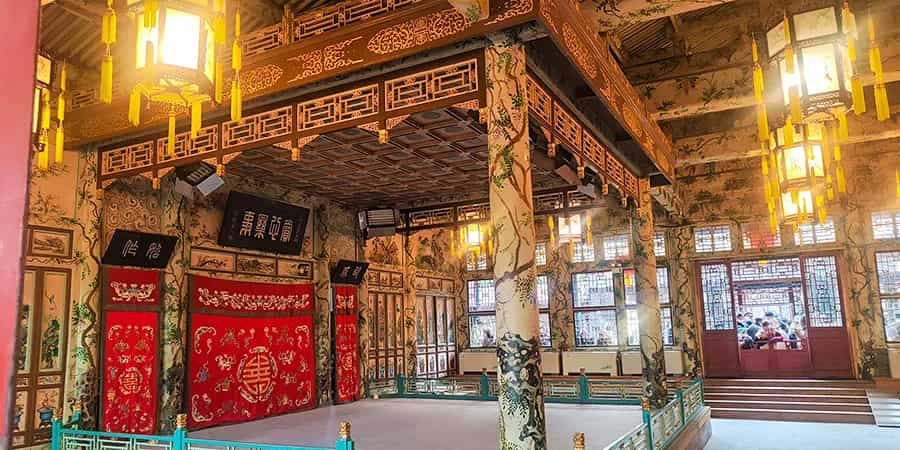
The Grand Theatre is a fully enclosed wooden opera house with no iron nails in its structure. Nine large ceramic jars were placed under the stage to enhance resonance, creating what has been described as a Qing Dynasty surround-sound system. It is the only princely wooden theatre of its kind in China.
4. The Fu Stele (One Treasure)
The Fu Stele is the mansion’s most treasured artifact. It bears a calligraphic character “Fu” (福, meaning fortune or blessing) written by Emperor Kangxi for his grandmother, Empress Dowager Xiaozhuang. The character is said to contain five blessings in one: longevity, wealth, health, virtue, and a peaceful end. It is hidden in a rockery cave called Miyun Cave in the garden. Visitors often queue to touch the stele for good luck.
Other Notable Sights
- Yin’an Hall: The main hall of the mansion, used for important ceremonies. Its scale reflects the rank of a Qing prince.
- Xijin Studio: A residence built with precious nanmu wood, originally used by Heshen. It is considered one of the most valuable buildings in the mansion.
- Bat Pool: A pond shaped like a bat, a symbol of good fortune. The bat motif appears throughout the mansion.
- Dule Peak: A large Taihu rock in the garden, one of the classic garden features.
- Cuijin Garden: The rear garden, blending northern and southern styles with rockeries, ponds, and pavilions.
Best Time to Visit
The best seasons are spring (April–May) and autumn (September–October). The garden is pleasant to walk, and the light is good for photography.
Arrive right at opening. The Fu Stele in particular attracts long queues later in the day. The first 30–45 minutes after opening are the quietest.
Avoid Chinese public holidays, especially National Day Golden Week (October 1–7), Labor Day holiday (around May 1–5), and Spring Festival.
Common Mistakes to Avoid
- Not booking in advance. There is no on-site ticket window. Reserve through the official WeChat account.
- Visiting on a Monday. The mansion is closed except on public holidays.
- Arriving in the afternoon. Last entry is 16:10 in peak season and 16:00 in off-season. The site also becomes very crowded.
- Skipping the Fu Stele queue strategy. Go there early or late, not in the middle of your visit when the line is longest.
- Using flash photography in Miyun Cave. Flash is prohibited near the Fu Stele.
- Buying expensive rubbings outside the gate. The official gift shop inside offers better value and authenticity.
- Trying to drive. Parking is nearly impossible in the hutong area. Take the metro.
- Forgetting your passport. It is required for entry with a real-name reservation.
What to Bring
- Passport and reservation confirmation
- Comfortable walking shoes
- Water and snacks (there are no restaurants inside the mansion)
- Sun protection in summer
- Warm layers in winter
- Power bank and mobile payment app
- Camera or phone for photos
Food and Drink Nearby
Prince Gong’s Mansion has no restaurant inside. Plan to eat before or after your visit.
- Huguosi Snack Street: About 15–20 minutes on foot. A classic spot for Beijing snacks such as fried sauce noodles, douzhi (fermented mung bean drink),驴打滚 (glutinous rice rolls), and men ding rou bing (meat-filled pancakes).
- Shichahai and Houhai: Lakeside restaurants and cafes, plus traditional Beijing cuisine. The bar street comes alive in the evening.
- Yandai Xiejie: A narrow diagonal street near Shichahai with small shops and snack stalls.
Final Thoughts
Prince Gong’s Mansion is one of Beijing’s most intimate and atmospheric historic sites. It is smaller than the Forbidden City and quieter than the Temple of Heaven, but it offers something those sites cannot: a close-up view of how a Qing prince actually lived.
With an advance reservation, an early start, and a no-backtrack route, you can see the Three Masterpieces and One Treasure without the worst crowds. And because it sits right beside Shichahai, it pairs perfectly with a hutong walk, a lakeside sunset, or a bowl of traditional Beijing noodles.
If you have half a day in Beijing and want to go beyond the headline attractions, Prince Gong’s Mansion is an excellent choice.
The perspective outlined regarding “Prince Gong’s Mansion Beijing Travel Guide:…” provides meaningful clarity on the subject. Appreciate the dedication to detailed analysis here. Keep up the great work!