Beihai Park is the oldest and best-preserved imperial garden in China. Located in the heart of Beijing, just northwest of the Forbidden City, it has served as a royal pleasure ground for more than a thousand years, spanning the Jin, Yuan, Ming and Qing dynasties. The park covers approximately 68 hectares, with nearly 39 hectares of water, and its design follows the classical Chinese principle of “one lake and three hills”.
For generations of Chinese children, Beihai is also the setting of a beloved song, “Let Us Row Our Oars,” which describes the white pagoda, green trees and red walls of the park. For travelers, it offers a rare combination of imperial architecture, serene lake scenery and living local culture — all for a ticket that costs less than a cup of coffee.
This guide will help you plan your visit, choose the right route, and make the most of Beijing’s most accessible royal garden.
Quick Facts
- Location: No. 1 Wenjin Street, Xicheng District, Beijing
- Oldest imperial garden in China: Over 1,000 years of continuous use
- Area: Approximately 68 hectares, including 39 hectares of water
- Scenic rating: 4A National Tourist Attraction
- Park entry: 10 RMB peak season; 5 RMB off-season
- Combo ticket: 20 RMB peak; 15 RMB off-season
- Best time to visit: Spring and autumn; early morning or late afternoon
- Recommended duration: 3–4 hours
- Must-have: Passport, advance reservation, comfortable shoes and water
Why Visit Beihai Park?
Beihai is not a museum piece. It is a living imperial garden where locals practice tai chi at dawn, families row boats on the lake in summer, and photographers gather at sunset to capture the White Dagoba reflected in the water.
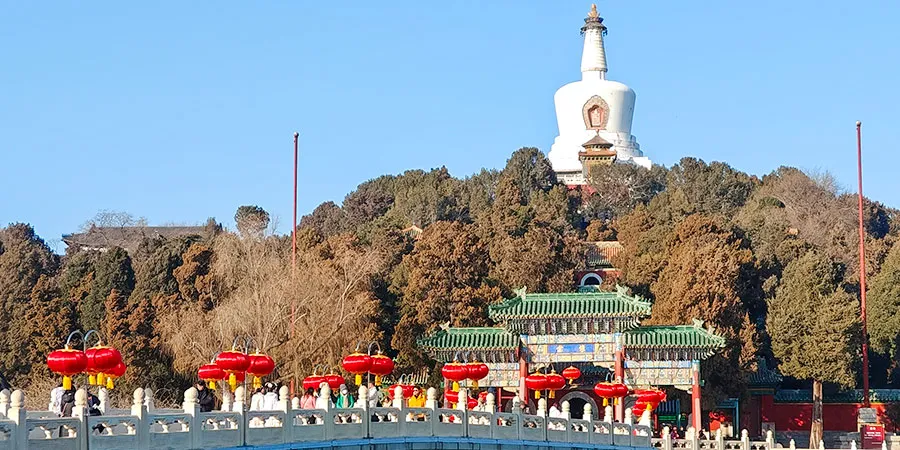
The park’s centerpiece is Qionghua Island, crowned by the 35.9-meter White Dagoba, a Tibetan-style Buddhist stupa built in 1651. From the top, you can see the entire park and the distant skyline of Beijing. The island is connected to the shore by the Yong’an Bridge, and the climb to the pagoda passes through Yong’an Temple, a tranquil complex of halls and courtyards.
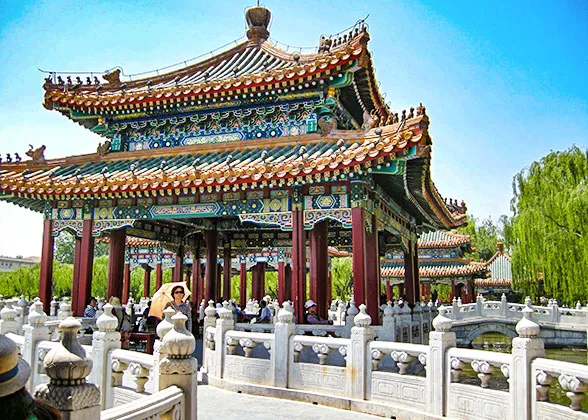
Beyond the island, Beihai holds several treasures. The Nine-Dragon Wall is the only double-sided glazed-tile dragon screen in China, with nine vivid dragons on each face. Jingxin Studio is a miniature Jiangnan-style garden within the garden, once used as a study by Emperor Qianlong. The Five Dragon Pavilions extend over the water, and Round City is a small fortress-like garden with a 1.5-meter jade Buddha and a Yuan dynasty jade jar.
Tickets: Buy the Combo Ticket
Beihai Park uses a two-tier ticket system. The basic entrance ticket gives you access to the park grounds and the lake area. The combo ticket adds the White Dagoba, Round City, and Jingxin Studio. If you want to climb to the White Dagoba — and you should — the combo ticket is essential.
Ticket prices:
| Ticket Type | Peak Season (Apr 1 – Oct 31) | Off-Season (Nov 1 – Mar 31) |
|---|---|---|
| Basic entrance | 10 RMB | 5 RMB |
| Combo ticket | 20 RMB | 15 RMB |
| Student (basic) | 5 RMB | 2.5 RMB |
| Student (combo) | 10 RMB | 7.5 RMB |
Free admission: Children under 1.2 meters, seniors aged 65 and above, military personnel, and disabled visitors enter free with valid ID.
How to book:
- Reservations are required. There is no on-site ticket window for general admission during peak periods.
- Use the official WeChat account “畅游公园” or “北京市北海公园” to reserve in advance.
- Tickets are released 7 days in advance. One passport can reserve one ticket per day.
- Enter by scanning your passport or ID card at the gate. No ticket exchange is needed.
Important: The inner gardens (Jingxin Studio, Huafang Studio and others) are closed on Mondays, except for public holidays.
Opening Hours
| Season | Park Opening | Last Entry | Park Closes |
|---|---|---|---|
| Peak (Apr 1 – Oct 31) | 6:00 | 20:30 | 21:00 |
| Off-Season (Nov 1 – Mar 31) | 6:30 | 19:30 | 20:00 |
The inner gardens and small courtyards typically open from 8:00 to 18:00 in peak season and 8:30 to 17:00 in off-season. Arrive in the morning if you want to enter the paid inner attractions; they close well before the park gates.
Note: Some areas may be temporarily closed for maintenance. As of mid-2026, the Kuaixue Hall courtyard and the Guke courtyard inside Huafang Studio were closed for restoration. Always check the official WeChat account for current closures before your visit.
Getting There
Beihai Park is in a dense hutong area with no dedicated parking. Public transport is strongly recommended.
- By Metro: Take Line 6 to Beihai North Station, Exit B. Cross the road and walk a few minutes to the North Gate. This is the most convenient access point.
- By Bus: Routes 5, 101, 103, 109, 124 and 128 stop at Beihai Station near the South Gate. Routes 13, 42, 107, 111, 118, 612 and 701 stop at Beihai North Gate Station.
- By Taxi: Ask to be dropped near the North Gate or South Gate. Drivers cannot enter the narrow hutong directly in front of the park.
- By Car: Not recommended. Parking is extremely limited and expensive on weekends.
Insider tip: The North Gate is the best starting point for the classic no-backtrack route. If you want to finish near the Forbidden City or Jingshan Park, exit from the South Gate.
Suggested Routes
3–4 Hour Classic No-Backtrack Route
North Gate → Jingxin Studio → Xitian Fanjing → Nine-Dragon Wall → Five Dragon Pavilions → Ferry to Qionghua Island → White Dagoba → East Shore (Haopu Jian) → South Gate → Round City
This is the most popular route and covers all the highlights without retracing your steps. Start at the North Gate, visit the serene Jingxin Studio first thing in the morning, then walk west to the Nine-Dragon Wall and the Five Dragon Pavilions. Take the ferry across the lake to Qionghua Island, climb to the White Dagoba, and descend along the east shore. Exit at the South Gate and visit Round City before leaving.
2–3 Hour Essential Route
South Gate → Yong’an Bridge → Yong’an Temple → White Dagoba → Ferry to Five Dragon Pavilions → Nine-Dragon Wall → North Gate
This route is ideal if you are short on time or arriving from the Forbidden City side. It focuses on the iconic White Dagoba and the northern highlights.
Family-Friendly Route
North Gate → Jingxin Studio → Nine-Dragon Wall → Five Dragon Pavilions → Boat on the Lake (paddle or electric) → White Dagoba (optional climb) → South Gate
This route minimizes uphill walking and includes a boat ride, which children love. The lake is the largest in any Beijing park, and renting a boat is one of the classic Beihai experiences.
Photography Route
North Gate at opening → Jingxin Studio (soft morning light) → Nine-Dragon Wall → Five Dragon Pavilions (late afternoon light) → Ferry to Qionghua Island → White Dagoba (golden hour) → West Shore for sunset reflection
The White Dagoba is best photographed from the east side of Qionghua Island, framed by pine branches. The Five Dragon Pavilions catch beautiful light in the late afternoon.
Must-See Highlights
- White Dagoba: The 35.9-meter Tibetan-style stupa is the symbol of Beihai. Climb to the top for panoramic views over the lake and the city. The pagoda was built in 1651 during the Shunzhi reign of the Qing Dynasty.
- Nine-Dragon Wall: Built in 1756, this glazed-tile screen is the only double-sided one in China. It is made of 425 colored glazed bricks and contains 635 dragons in its design. In sunlight, the colors are dazzling.
- Jingxin Studio: A “garden within a garden” modeled after Jiangnan-style landscaping. It was built by Emperor Qianlong for his son. The rockeries, winding corridors and reflective pools make it one of the most photogenic spots in the park.
- Five Dragon Pavilions: Five connected pavilions extending over the water on the north shore. They are a classic spot for views of the White Dagoba across the lake, especially at sunset.
- Round City: A small fortress-like garden at the South Gate, home to a 1.5-meter jade Buddha and a Yuan dynasty jade jar. It is included in the combo ticket.
- Yong’an Temple: The temple complex on Qionghua Island, leading up to the White Dagoba. It contains several halls with Buddhist statues and quiet courtyards.
- Xitian Fanjing: A temple complex with a main hall built from precious nanmu wood, located near the Nine-Dragon Wall.
- Lake Boating: Rowing a boat on the lake is a quintessential Beihai experience. Paddle boats and electric boats are available for rent at the west shore wharves.
Best Time to Visit
The best seasons are spring (April–May) and autumn (September–October). The weather is mild, and the garden is at its most beautiful.
Spring brings cherry blossoms, lilacs and peach blossoms. The White Dagoba framed by flowering trees is a classic Beijing photo.
Summer (June–August) is peak boating season. The lake is covered with lotus flowers from June to August, and the annual Lotus Festival features more than a hundred varieties. The park stays open until 22:00 in June and August.
Autumn offers golden ginkgo and maple foliage along the shores. The light is crisp, and the lake reflections are spectacular.
Winter is quiet and cold. Snow on the White Dagoba and the frozen lake create a stark, contemplative beauty.
Best time of day: Arrive right at opening (6:00–6:30 AM) for quiet paths and soft light, or visit after 16:00 for golden-hour photography around the Five Dragon Pavilions and the lake.
Avoid Chinese public holidays, especially National Day Golden Week (October 1–7) and Labor Day holiday (around May 1–5).
Common Mistakes to Avoid
- Buying only the basic ticket. You cannot climb to the White Dagoba or enter Round City and Jingxin Studio without the combo ticket. Buy the 20 RMB combo.
- Visiting on a Monday. The inner gardens are closed on Mondays. The park itself remains open, but you will miss Jingxin Studio and other highlights.
- Not booking in advance. Reservations are required through the official WeChat account. There is no on-site ticket window during peak periods.
- Forgetting your passport. Real-name entry requires it.
- Starting from the South Gate if you want the classic route. The North Gate is the better starting point for a no-backtrack walk. The South Gate is better as an exit.
- Underestimating the climb to the White Dagoba. It is a steep walk up Qionghua Island. Wear comfortable shoes and take your time.
- Missing Jingxin Studio. It is tucked away in the northeast corner and is one of the finest gardens in Beijing. Visit it first thing in the morning.
- Trying to drive. Parking is nearly nonexistent. Take the metro.
- Expecting a quick visit. Beihai deserves at least 3 hours. Rushing through in an hour means missing its best corners.
- Not checking temporary closures. Some courtyards may be closed for restoration. Check the official account before you go.
What to Bring
- Passport and reservation confirmation
- Comfortable walking shoes (there are many stone paths and stairs)
- Water and snacks
- Sun protection in summer
- Warm layers in winter
- Power bank and mobile payment app
- Camera or phone for photos
- Insect repellent in summer evenings (mosquitoes near the lake)
Food and Drink Nearby
There are a few dining options inside the park, including Qingfeng Steamed Bun Shop, but the surrounding neighborhood offers far more variety.
- Shichahai and Houhai: Just outside the North Gate. Lakeside restaurants, cafes and bars, plus traditional Beijing snacks.
- Huguosi Snack Street: About 15 minutes on foot from the North Gate. Famous for douzhi (fermented mung bean drink), fried sauce noodles, and glutinous rice rolls.
- Jingshan Park area: If you exit from the East Gate, Jingshan Park is directly opposite. The area has small local restaurants and is close to the Forbidden City.
- Nanluoguxiang: A lively hutong street about 20 minutes on foot from the North Gate, with snacks, cafes and shops.
Final Thoughts
Beihai Park is one of Beijing’s most rewarding experiences. It is older than the Forbidden City, more intimate than the Summer Palace, and more affordable than almost any other major attraction in the city. For the price of a basic ticket, you can spend an afternoon among imperial pavilions, ancient trees and a lake that has been admired for a thousand years.
With an advance reservation, an early start and the combo ticket, you can see the White Dagoba, the Nine-Dragon Wall and Jingxin Studio without the worst crowds. And when you stand on the shore at sunset, watching the white pagoda glow against the sky, you will understand why Beihai has inspired poets, painters and children’s songs for generations.