The Imperial Ancestral Temple is the royal ancestral shrine of the Ming and Qing dynasties, built in 1420 on the east side of Tiananmen and directly opposite Zhongshan Park. Today it operates as the Beijing Working People’s Cultural Palace, a walled park of halls, stone bridges, and ancient cypress trees that sits beside the Forbidden City yet draws a fraction of its crowds.
Its significance is architectural and ritual. Emperors came here to sacrifice to their ancestors before enthronement, after victories, and on other state occasions, and the complex forms part of the Beijing Central Axis, inscribed on the UNESCO World Heritage List in 2024. The main Sacrificial Hall, often called the Hall of Enjoyment, is one of the highest-ranked timber structures surviving from imperial China.
This guide covers what to see, how tickets and opening hours work, how to reach the gates, suggested routes, seasonal timing, common mistakes, and where to eat nearby. Prices and hours have changed over time and sources disagree, so treat every figure as a check-before-you-go detail.
Quick Facts
| Item | Detail |
|---|---|
| Location | East of Tiananmen Rostrum, Dongcheng District, Beijing, opposite Zhongshan Park |
| History | Built in 1420 as the imperial ancestral temple; renamed the Beijing Working People’s Cultural Palace in the 1950s |
| Status | Major national heritage site; component of the Beijing Central Axis UNESCO World Heritage listing (2024) |
| Area | Sources give roughly 13.3 to 16.4 hectares |
| Admission | Historically a nominal park fee, with a separate or combined ticket for the main hall; confirm current prices officially |
| Best time | Spring and autumn for light and comfort; early morning for quiet |
| Duration | 1 to 2 hours for the park; 2 to 3 hours with the main hall and photography |
| Essential preparation | Carry your passport, check the official channel for hours and tickets, and expect security checks near Tiananmen |
Why Visit the Imperial Ancestral Temple?
The temple was the ritual heart of imperial family worship. During the Ming and Qing dynasties, the emperor came here to report major events to his ancestors, and the site was laid out to mirror the Forbidden City in symmetry and scale. The pairing with the Altar of Land and Grain, now Zhongshan Park, expresses the classical “left ancestor, right society” plan of the ideal capital.
The architecture is the main draw. The central axis runs from the Glazed Gate through the Jinshui Bridges and Halberd Gate to the Sacrificial Hall, the Resting Hall, and the Distant Kin Temple. The Sacrificial Hall stands on a three-tiered stone base with a double-eaved roof, and its interior is famed for rows of massive nanmu wood columns and golden brick paving.
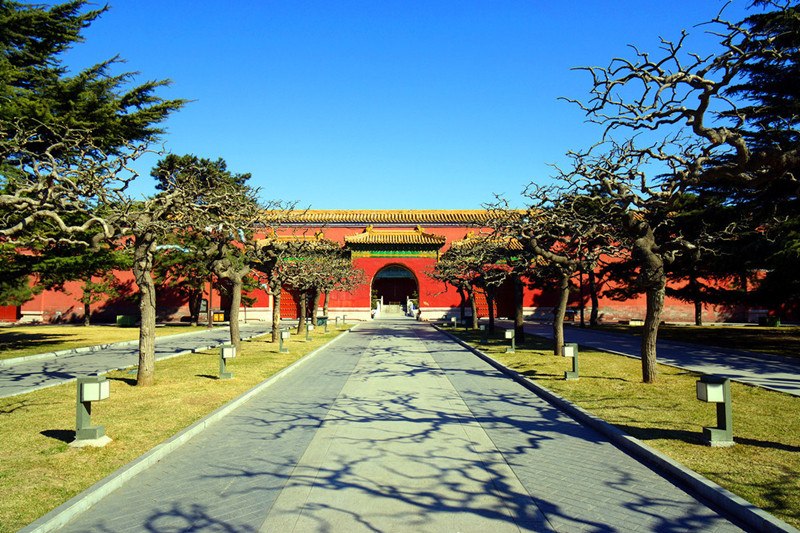
Compared with the Forbidden City, the experience is calm. More than 700 ancient cypresses shade the outer courtyard, red walls and yellow tiles frame quiet courtyards, and you can study details without being carried along by a crowd. History-minded travelers, architecture fans, photographers, and anyone wanting a royal-scale site without the crush will find it rewarding.
Tickets: Buy Through Official Channels and Ignore Scalpers
Ticket information is the least stable part of planning. Older sources list a nominal park fee of RMB 2, while recent traveler reports describe a park ticket plus a separate or combined ticket for the main hall, with seasonal pricing. Treat all amounts as indicative and confirm on the official channel or at the gate before you rely on them.
| Ticket type | Indicative price | Notes |
|---|---|---|
| Park admission | Historically a nominal fee around RMB 2; check the official channel for the current price | Covers the park grounds and courtyards |
| Main hall / exhibition ticket | Recent reports mention roughly RMB 10 to 15 depending on season, sometimes including park entry; verify officially | Needed to enter the Sacrificial Hall interior |
| Concessions | Reports mention free or reduced entry for seniors, children, students, disabled visitors, and local union members; eligibility and proof requirements must be confirmed | Bring supporting documents |
| Booking | Sources disagree on whether advance booking is required; check the official channel, especially around holidays | Buy only from official counters or official online channels |
| Payment | Mobile payment is widely used in Beijing; keep a card or cash backup and expect passport checks | Carry your passport for identification |
Buy only from official counters or official online channels. Unofficial resellers near Tiananmen sometimes offer “skip the line” tickets at inflated prices, and these are not a reliable way in. If a website demands unusual personal details or payment methods, close it and use the official channel instead.
Opening Hours
Opening hours differ between the park and the main hall, and they change with the season. The table below summarizes the ranges reported by sources; the official channel is the only reliable authority on the day you visit.
| Area | Season | Reported hours |
|---|---|---|
| Park | Peak season (roughly April to October) | Reports range from about 6:30 to 19:30; some sources say 20:00 |
| Park | Off-season (roughly November to March) | Reports range from about 7:00 to 17:30 or 18:00 |
| Main hall and exhibition | Daily | Typically around 9:00 to 16:30, with last entry earlier |
| Main hall | Monday | Several sources say the main hall closes on Mondays except public holidays; park rules are less clear, so verify |
| Whole site | Chinese public holidays | Hours and closures may be adjusted; check ahead |
Arrive with a buffer. Security screening near Tiananmen can take time, and the main hall may stop admitting visitors well before the park closes. If the hall is your priority, plan a morning visit and confirm the day’s schedule at the gate.
Getting There
The temple sits immediately east of Tiananmen, so public transport is far easier than driving. Metro Line 1 serves Tiananmen East station, and traveler reports most often mention exits B or C for the short walk to the site; signage and exit assignments can change, so follow station signs rather than a fixed exit number. Line 8 stations west of the complex are also within walking distance.
Several city buses stop near Tiananmen East, but route numbers change over time, so check a current map app. Taxis and ride-hailing can drop you near the Tiananmen area, though security restrictions may force a short walk. Driving is not recommended: parking around Tiananmen is limited and access is controlled.
The complex has multiple gates. The south gate beside Tiananmen is the ceremonial approach, while traveler reports describe the east and west gates as practical entrances, with some tickets only accepted at certain gates. Check which gate matches your ticket before walking the full perimeter.
Insider tip: visit early in the morning, when the cypress courtyards are quiet and the light on the red walls is soft. You can then cross to the Forbidden City or Zhongshan Park while the day is still cool.
Suggested Routes
| Route | Duration | Best for | Terrain |
|---|---|---|---|
| Quick Royal Core | 1 to 1.5 hours | Short stop, first-time visitors | Flat paved courtyards, some steps |
| Architecture and Ritual | 2 to 3 hours | History and architecture fans | Flat, with stone platforms and stairs |
| Photographer’s Red Walls | 2 hours | Photography, quiet corners | Flat, uneven old paving in places |
| Central Axis Day | Half day | Combining nearby royal sites | Long walking day, mostly flat |
Quick Royal Core
Duration: 1 to 1.5 hours. Start: East or west gate. End: South gate area.
Gate → Glazed Gate → Jinshui Bridges → Halberd Gate → Sacrificial Hall exterior → Resting Hall → cypress courtyard → exit. This route keeps to the main axis and gives a clear sense of the ritual sequence. The terrain is flat paving with a few steps onto stone platforms.
Architecture and Ritual
Duration: 2 to 3 hours. Start: East gate. End: West gate or south gate.
East gate → cypress grove → Glazed Gate → Jinshui Bridges → Halberd Gate → Sacrificial Hall and main hall exhibition → Resting Hall → Distant Kin Temple → side halls → west gate. Allow time inside the main hall for the columns, ceiling paintings, and golden brick floor. Expect stairs and stone thresholds.
Photographer’s Red Walls
Duration: 2 hours. Start: South gate. End: East gate.
South gate → Glazed Gate arch → stone bridges → east corridor → Sacrificial Hall terrace → rear courtyards → ancient cypresses → east gate. Morning and late afternoon give the best side light on the red walls. The ground is mostly flat but old paving can be uneven.
Central Axis Day
Duration: Half day. Start: Tiananmen East. End: Forbidden City or Zhongshan Park.
Tiananmen East → Imperial Ancestral Temple → Zhongshan Park → Tiananmen Square viewpoints → Forbidden City entrance. This is a long walking day on flat ground with heavy security screening. Book any separate Forbidden City ticket well in advance through its official channel.
Must-See Highlights
- Sacrificial Hall (Hall of Enjoyment): The ritual centerpiece, standing on a three-tiered stone base with a double-eaved roof. Look up at the ceiling paintings and down at the golden brick floor, and note the massive nanmu columns. Check whether the interior is open on your visit day.
- Glazed Gate: The colorful entrance screen on the central axis sets up the symmetry of the whole complex. Stand centered for the classic framed view.
- Jinshui Bridges: Several stone bridges span the Golden River at the southern end of the main courtyard. They are a quiet spot for photographs early in the day.
- Halberd Gate: The gate between the bridges and the main hall marks the transition into the most sacred part of the complex. Study the roof form and the scale of the doorway.
- Resting Hall: Behind the Sacrificial Hall, this hall stored ancestral spirit tablets in normal times. It is calmer than the main hall and rewards a slow look at the structure.
- Distant Kin Temple: Added in the late 15th century to the north of the Resting Hall, it enshrined more distant imperial ancestors and completes the axial sequence.
- Ancient Cypress Grove: More than 700 old cypresses shade the outer courtyard and create the solemn atmosphere of a sacrificial site. The dappled light is best in the morning.
- Chinese Harmony Bell exhibition: A set of bells modeled on the chime bells from the Tomb of Marquis Yi of Zeng, rung to welcome the year 2000. It sits inside the main hall area and may require the hall ticket.
Best Time to Visit
Spring and autumn are the most comfortable seasons, with mild temperatures and good light on the red walls and yellow roofs. Spring magnolias near the south gate are a known draw, usually blooming around mid-March for about a week, though exact dates vary by year.
Summer is hot and humid, so visit at opening time and carry water; the cypress shade helps but does not remove the heat. Autumn brings clear skies and, according to traveler reports, osmanthus displays in October. Winter is cold but quiet, and low sun can make the courtyards feel especially atmospheric.
Early morning is the best time of day for calm and photography. Avoid Chinese public holidays such as National Day in early October and the Spring Festival period, when Tiananmen-area security and crowds intensify. The site is not a night-visit attraction; plan around daylight hours.
Common Mistakes to Avoid
- Assuming the Forbidden City ticket covers it. The Imperial Ancestral Temple is a separate site with its own ticket; book each official channel separately.
- Trusting old prices. Sources list different fees and seasonal rates, so check the official channel rather than a years-old blog.
- Arriving on a Monday without checking. The main hall is reported to close on Mondays except public holidays; confirm before making it your priority.
- Leaving the main hall for late afternoon. It typically closes around 16:30, well before the park, so go early.
- Forgetting your passport. Security checks near Tiananmen are routine, and identification may be requested.
- Using the wrong gate. Some tickets are tied to specific entrances; check which gate accepts yours.
- Buying from touts. Unofficial resellers near Tiananmen are not a reliable entry route; use official counters or channels.
- Underestimating security queues. Allow extra time around Tiananmen, especially on weekends and holidays.
- Bringing prohibited equipment. Long selfie sticks, tripods, and similar gear may be restricted; check current rules and travel light.
- Treating it as a quick photo stop. The architecture rewards at least an hour, and the main hall needs more.
- Ignoring the cypress courtyards. Many visitors rush to the halls and miss the shaded outer areas that give the site its atmosphere.
- Relying only on cash or only on a phone. Mobile payment is common in Beijing, but keep a backup payment method and small notes.
What to Bring
- Passport or official photo ID for security checks.
- Comfortable walking shoes for stone paving and stairs.
- Water bottle, especially in summer.
- Sun hat and sunscreen in warm months.
- Light layers in spring and autumn; a warm coat in winter.
- Phone with a map app and mobile payment set up.
- Small cash backup for incidentals.
- Camera or phone with a wide lens for courtyard and hall shots.
- A light rain jacket in summer.
- A small bag that is easy to open at security checks.
Food and Drink Nearby
Dining inside the complex is limited, so plan meals before or after your visit. The surrounding Dongcheng and Wangfujing areas offer the most dependable choice.
- Wangfujing area: About 1.5 to 2 km east, with shopping-mall food halls and restaurants at mid to high prices; good for a sit-down meal after the temple.
- Qianmen and Dashilar area: South of Tiananmen, roughly 2 km away, with traditional snack shops and casual restaurants at low to mid prices.
- Nanchizi and Donghuamen area: Within a short walk east of the complex, with cafes and small eateries at mid prices; useful for a quick lunch.
- Zhongshan Park area: Across the axis to the west, with simple snacks and drinks at low prices; convenient if you continue to the park.
Restaurant names and opening hours change frequently, so check a current map app before walking to a specific venue. Carry water for the visit itself, as options inside the walls are limited.
Final Thoughts
The Imperial Ancestral Temple offers royal-scale architecture, a ritual history that spans the Ming and Qing dynasties, and a calm that the Forbidden City rarely provides. Plan one to two hours for the park and up to three if you include the main hall and photography, and confirm tickets and hours on the official channel before you go.
The lasting image is simple: rows of dark cypress trunks framing a red wall, with the yellow roof of the Sacrificial Hall rising beyond and almost no one else in the courtyard.
Sources
- China.org.cn: Working People's Cultural Palace
- China.org.cn: Cultural Palace feature
- China.org.cn: Imperial Ancestral Temple filming site
- Trip.com: Imperial Ancestral Temple moment
- Trip.com: Imperial Ancestral Temple guide
- Trip.com: Imperial Ancestral Temple theme
- Trip.com: Imperial Ancestral Temple attractions
- Visit Beijing: Working People's Cultural Palace
- Visit Beijing: Imperial Ancestral Temple