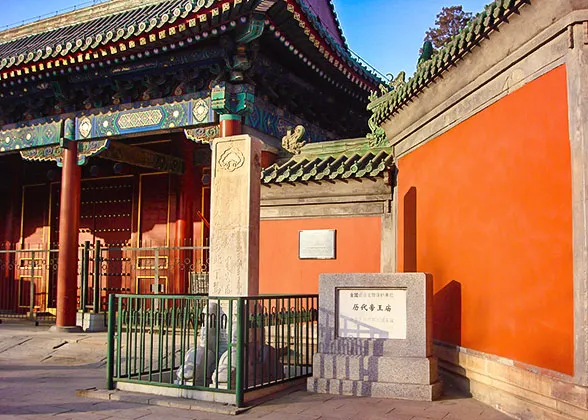
The Temple of Ancient Monarchs is a walled imperial shrine in Beijing’s Xicheng District, built to honor rulers of China’s past dynasties. Ming and Qing emperors came here to make offerings to the Three Sovereigns, the Five Emperors, and the monarchs who followed them. The complex sits on Fuchengmen Inner Street, a short walk from the White Pagoda Temple and the old hutong lanes around Xisi.
Construction began in 1530, in the ninth year of the Jiajing reign of the Ming Dynasty. Over roughly 380 years, the temple hosted hundreds of state sacrifices, and its political standing was compared with the Imperial Ancestral Temple and the Confucius Temple. Today it is a quiet, compact site where red walls, yellow roof tiles, and ancient cypress trees frame one of the most unusual memorial halls in the capital.
This guide covers what to see, how ticketing and opening hours work, how to reach the temple by metro, and how to combine it with nearby sights. It also flags where sources disagree, so you can confirm the essentials before setting out.
Quick Facts
| Location | Fuchengmen Inner Street, Xicheng District, Beijing, near the White Pagoda Temple |
|---|---|
| History | Founded in 1530 under the Ming Jiajing emperor; used for imperial sacrifices through the Qing Dynasty |
| Status | Rated AA as a scenic site; listed as a national key cultural relic protection unit |
| Area | About 21,500 square meters, with roughly 6,000 square meters of ancient buildings |
| Admission | Reported at 20 RMB for adults; confirm current pricing and concessions on the official channel |
| Best time | Spring and autumn for comfortable walking; quieter on weekday mornings |
| Suggested duration | About 1 hour for the temple; 3 to 5 hours with nearby hutong sights |
| Essential preparation | Carry your passport, check opening days and reservation rules, and bring a mobile payment app as backup |
Why Visit the Temple of Ancient Monarchs?
Few sites in Beijing tell the story of Chinese political continuity so directly. The main hall, Jingde Chongsheng Hall, enshrines spirit tablets for 188 emperors, from the legendary Three Sovereigns and Five Emperors through the Ming and Qing dynasties. The east and west wing halls hold tablets for 79 ministers and generals, including figures such as Zhuge Liang and Yue Fei.
The architecture is the other draw. The hall is supported by 60 large nanmu columns, and its scale is often described as second only to the Hall of Supreme Harmony in the Forbidden City. Four stele pavilions preserve inscriptions from the Yongzheng and Qianlong emperors, while a long glazed screen wall and a six-script dismounting stele mark the entrance.
Guan Yu, the deified Three Kingdoms general, has a separate shrine in the west courtyard, creating a temple-within-a-temple layout. Exhibitions in the side halls explain the sacrificial system and the family-name traditions linked to the legendary ancestors. History-minded travelers, architecture fans, and anyone seeking a calm alternative to the Forbidden City crowds will find the visit rewarding.
Tickets: Buy at the Gate and Confirm the Price First
Sources consistently report adult admission of 20 RMB, with half-price student tickets mentioned in traveler accounts. Free entry for seniors aged 60 and over, military personnel, and disabled visitors is also reported, but these concessions are not confirmed by an official scenic-area page. Treat all pricing as subject to change and check the official channel before you travel.
| Ticket type | Reported price | Notes |
|---|---|---|
| Adult | 20 RMB | Most commonly reported figure; confirm on arrival |
| Student | About 10 RMB | Half price reported; valid student ID likely required |
| Seniors 60+, military, disabled | Free (reported) | Verification documents may be requested |
| Wednesday free allocation | Free (reported) | Limited numbers reported; not officially confirmed |
Booking advice is contradictory. Some traveler posts say advance online reservation is required, while another says tickets must be bought at the window and that online or on-site reservations are not accepted. The safest approach is to check the temple’s official WeChat account or call ahead, then arrive with your passport and enough time to buy at the gate.
Avoid touts and unofficial resellers. If a third-party platform sells a ticket, confirm that it is an authorized channel and that entry with a foreign passport is supported. Do not pay a premium for a “skip-the-line” product unless the official source confirms it exists.
Opening Hours
Opening days are the biggest uncertainty. The Xicheng District government route and several traveler reports say the temple opens Tuesday to Sunday from 9:00 to 17:00, with ticket sales or last entry at 16:30. The Visit Beijing attraction pages list 9:00 to 16:30 and state closure on Monday and Tuesday. Because these accounts conflict, confirm the current schedule before making the trip.
| Source or season | Reported hours | Closure notes |
|---|---|---|
| Xicheng District government route | 9:00-17:00, ticket sales end 16:30 | Tuesday to Sunday |
| Visit Beijing attraction pages | 9:00-16:30, entry stops 16:00 | Closed Monday and Tuesday |
| Traveler reports | 9:00-17:00, last entry 16:30 | Monday closure most often cited |
| Public holidays | Usually adjusted | Check official notices for extended or reduced hours |
Last entry matters more than closing time, because the halls and courtyards need at least an hour. Arrive by mid-afternoon at the latest. During Chinese public holidays such as National Day and Spring Festival, schedules may shift and crowds may increase, so check official notices in advance.
Getting There
The temple is on Fuchengmen Inner Street in Xicheng District, close to the White Pagoda Temple. By metro, Fuchengmen Station on Line 2 is the usual approach, with Exit B cited in traveler reports and a walk of roughly 700 meters. Xisi Station on Line 4 is another option, about 1 kilometer away. Exact exits and walking routes should be confirmed on a current metro map or map app.
Several bus routes are reported to stop near the White Pagoda Temple, including routes 101, 102, and 103, plus routes 3, 7, and 13. Bus numbering and stops change, so verify on a local transit app. Taxis and ride-hailing are convenient, but the surrounding hutong streets are narrow and traffic can be slow.
Driving is not recommended. Parking in the old lanes is limited, and the area is best explored on foot. If you arrive by car, plan to park in a commercial garage near Fuchengmen or Xisi and walk from there.
Insider tip: Approach from the White Pagoda Temple side and walk east along the red walls. The sequence gives you a natural orientation and a quieter arrival than coming straight from the main road.
Suggested Routes
| Route | Duration | Best for | Terrain |
|---|---|---|---|
| Temple in Focus | 1-1.5 hours | History and architecture | Flat courtyards and stone paving |
| White Pagoda and Emperors | 2.5-3 hours | First-time visitors | Flat streets with some steps |
| Xisi Heritage Walk | 4-5 hours | Half-day city walk | Flat, about 2-2.5 km |
| Old Beijing Full Day | 6-8 hours | Deep cultural immersion | Flat but long; mix of streets and courtyards |
Route 1: Temple in Focus
Duration: 1-1.5 hours. Start and end: Main gate. Terrain: Flat courtyards and stone paving.
Main gate → glazed screen wall → Jingde Gate → Jingde Chongsheng Hall → east wing hall exhibition → west wing hall exhibition → stele pavilions → Guandi Temple → exit.
This route concentrates on the core sacrificial axis and the side exhibitions. Allow extra time in the main hall to read the tablet layout and admire the nanmu columns.
Route 2: White Pagoda and Emperors
Duration: 2.5-3 hours. Start: Fuchengmen metro area. End: Xisi metro area. Terrain: Flat streets with some steps at temple entrances.
Fuchengmen Station → Baitasi East Alley → Miaoying Temple (White Pagoda) → Fuchengmen Inner Street → Temple of Ancient Monarchs → Guangji Temple exterior → Xisi Station.
This is the classic pairing for first-time visitors. The red wall and white pagoda view in Baitasi East Alley is a popular photo stop, and the temple provides a quiet contrast afterward.
Route 3: Xisi Heritage Walk
Duration: 4-5 hours. Start: Fuchengmen Station. End: Xisi Station. Terrain: Flat, about 2-2.5 km of walking.
Beijing Lu Xun Museum → Gongmenkou hutong lanes → Baitasi East Alley → Miaoying Temple → Temple of Ancient Monarchs → Guangji Temple → Zhengyang Bookstore → Xisi area.
The district government promotes this corridor as a classic urban stroll. Check each site’s opening days, since the Lu Xun Museum and the temple may close on different days.
Route 4: Old Beijing Full Day
Duration: 6-8 hours. Start: Fuchengmen Station. End: Xisi or Xishiku area. Terrain: Flat but long, with a mix of streets and courtyards.
Lu Xun Museum → Gongmenkou Xicha cafés → Baitasi East Alley → Miaoying Temple → Temple of Ancient Monarchs → Guangji Temple → Zhengyang Bookstore → 1901 café building → Xishiku Church.
This route suits travelers who want old Beijing atmosphere rather than a checklist of major sights. Start early, keep meal breaks flexible, and confirm opening hours for every interior stop.
Must-See Highlights
- Jingde Chongsheng Hall: The main hall holds tablets for 188 emperors and is supported by 60 nanmu columns. Stand at the center aisle to appreciate the scale, and check whether interior photography is permitted.
- Three Sovereigns and Five Emperors tablets: The central niche honors Fuxi, the Yan Emperor, and the Yellow Emperor. Read the labels before entering to understand the arrangement.
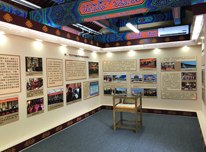
- East and west wing halls: These hold tablets for 79 ministers and generals and host exhibitions on the temple’s history and the sacrificial system. Allow 20 to 30 minutes.
- Stele pavilions: Four pavilions preserve inscriptions from the Yongzheng and Qianlong reigns. Look for the calligraphy and the stone carving details.
- Glazed screen wall: The long screen wall near the entrance sets the imperial tone. It is a good first photo stop before the crowds build.
- Six-script dismounting stele: The inscription in multiple scripts told officials to dismount at the gate. It is a small detail with a clear message about rank and respect.
- Guandi Temple: The separate shrine to Guan Yu sits in the west courtyard. Its position reflects his elevated status beyond that of an ordinary general.
- Ancient cypress trees: The courtyard trees give the complex its solemn atmosphere. They also provide shade in summer and strong silhouettes in winter.
- Family-name exhibition: Displays in the Divine Depot area link major Chinese surnames to the legendary ancestors. It adds context for visitors interested in genealogy.
Best Time to Visit
Spring and autumn are the most comfortable seasons, with mild temperatures and good light on the red walls. April to May and September to November are often recommended. Summer brings heat and occasional rain, so visit in the morning and carry water. Winter is cold but quiet, and the bare cypress branches make the architecture easier to see.
Morning is generally calmer, while late afternoon light is flattering for photography. The temple is a daytime site, and no reliable source confirms regular night access. Avoid Chinese public holidays such as National Day in early October and Spring Festival, when nearby hutong areas become busy.
Weekdays are quieter than weekends. If your schedule allows, pair the temple with the White Pagoda Temple on a weekday morning and save the busier hutong cafés for lunch.
Common Mistakes to Avoid
- Assuming the temple is open every day. Sources disagree on Monday and Tuesday closures. Check the official channel before traveling across the city.
- Arriving too late. Last entry is usually 16:30 or earlier, and the halls need at least an hour. Aim for early afternoon.
- Relying on a single booking rule. Some sources say reservations are required, others say tickets are sold only at the window. Confirm directly.
- Forgetting your passport. Foreign visitors should carry their passport for ticket checks and any registration requirements.
- Expecting Forbidden City scale. The temple is compact. Plan one hour for the core halls rather than a half day.
- Missing the side halls. The exhibitions explain the sacrificial system and are easy to skip if you rush the main axis.
- Ignoring the Guandi Temple. The separate shrine in the west courtyard is a distinctive feature and often overlooked.
- Visiting during a public holiday without a plan. Nearby hutong streets get crowded. Go early and book any restaurant or café you rely on.
- Assuming cards are accepted everywhere. Set up a mobile payment app as backup, and carry some cash for small vendors.
- Bringing prohibited equipment. Security checks may apply at cultural sites. Leave drones and large professional rigs behind unless permission is confirmed.
- Treating reported prices as fixed. The 20 RMB figure is widely reported but not officially confirmed. Bring extra cash or a payment method.
- Rushing the hutong approach. The lanes around Baitasi East Alley are part of the experience. Allow time to walk slowly and read the street life.
What to Bring
- Passport or official photo ID for ticket checks
- Comfortable walking shoes for stone paving and hutong lanes
- Mobile phone with a map app and translation app
- Mobile payment app set up, plus a small amount of cash
- Water bottle, especially in summer
- Sun hat and sunscreen in warm months
- Light rain jacket or folding umbrella in summer
- Warm layers and gloves in winter
- Camera or phone with enough storage for architecture photos
- Small daypack that is easy to carry through narrow halls
- Snacks if you plan a long hutong walk
- Any medication you need, since nearby pharmacies may not stock familiar brands
Food and Drink Nearby
The lanes around Gongmenkou and Baitasi East Alley have a changing mix of cafés, snack shops, and small restaurants. Exact businesses open and close frequently, so treat the following as dependable areas rather than fixed recommendations.
- Gongmenkou Xicha area: A lively street with cafés and eateries, a few minutes’ walk from the temple. Expect casual prices and Beijing snacks.
- Baitasi East Alley: Cafés with terraces and views toward the White Pagoda. Prices are moderate to high for the area; confirm opening hours.
- Fuchengmen Inner Street: Convenience stores and quick-service shops near the metro station. Good for water and simple meals.
- Xisi area: A broader choice of Beijing restaurants and noodle shops within a 15- to 20-minute walk. Prices vary from budget to mid-range.
For a sit-down meal, the hutong lanes north of the temple offer the most atmosphere. Check recent reviews and opening hours, and avoid anywhere that looks closed or empty outside peak meal times.
Final Thoughts
The Temple of Ancient Monarchs is a compact, deeply layered site that rewards an hour of slow looking. Its 188 emperor tablets, nanmu columns, and quiet courtyards tell a story of imperial continuity that most Beijing itineraries skip. Plan for about one hour inside, or three to five hours if you add the White Pagoda Temple and the surrounding lanes. Confirm opening days and ticket rules before you go, carry your passport, and arrive by early afternoon. The memorable image is simple: red walls, yellow tiles, and old cypress shadows falling across a hall built to honor centuries of rulers.
Sources
- Trip.com traveler notes on the temple
- Trip.com moments guide to the temple
- Xicheng District Government stroll route
- Visit Beijing official attraction page
- Trip.com attraction listing
- Visit Beijing detailed temple profile
- Trip.com Russian-language moments guide
- Visit Beijing attraction page (alternate URL)
- Trip.com Q&A moments guide
- Xicheng District Government stroll route (alternate URL)